Introduction
When Li Daoyuan of the Northern Wei recorded the source of the Jin River, this place was the “Shrine of Tang Shuyu”: on the west bank of the pool the mountain rose above the water, a cool hall spanned a flying bridge over the stream, and mingled trees cast their shade on either side — the finest spot along the Jin. In the twentieth year of Zhenguan, Emperor Taizong of the Tang, returning from his campaign in Liaodong by way of Bingzhou, personally composed the Inscription and Preface for the Shrine of Jin and wrote it out for engraving on a stele. The stele’s head bore the nine characters “the twenty-sixth day of the first month of the twentieth year of Zhenguan” in “flying-white” script; the stone was over a zhang high and four chi wide, and was later sheltered by a “Zhenguan Baohan” pavilion, though by the late Qing “many characters were worn away, the lower part especially so.”
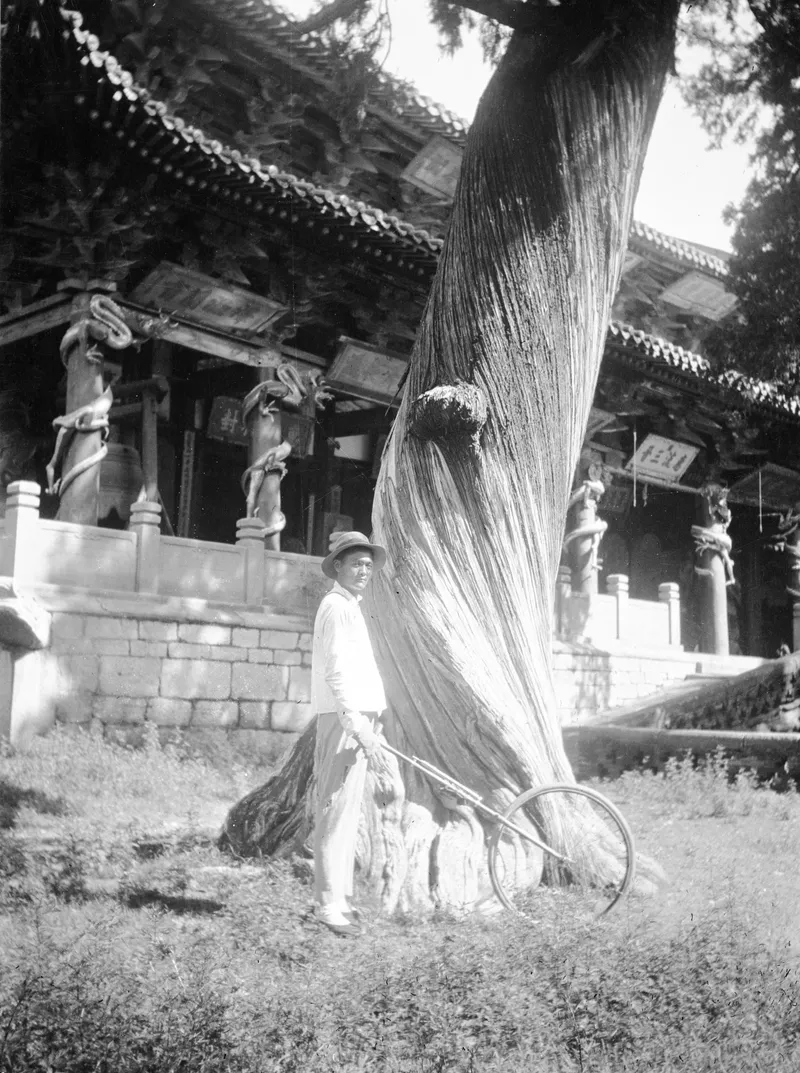
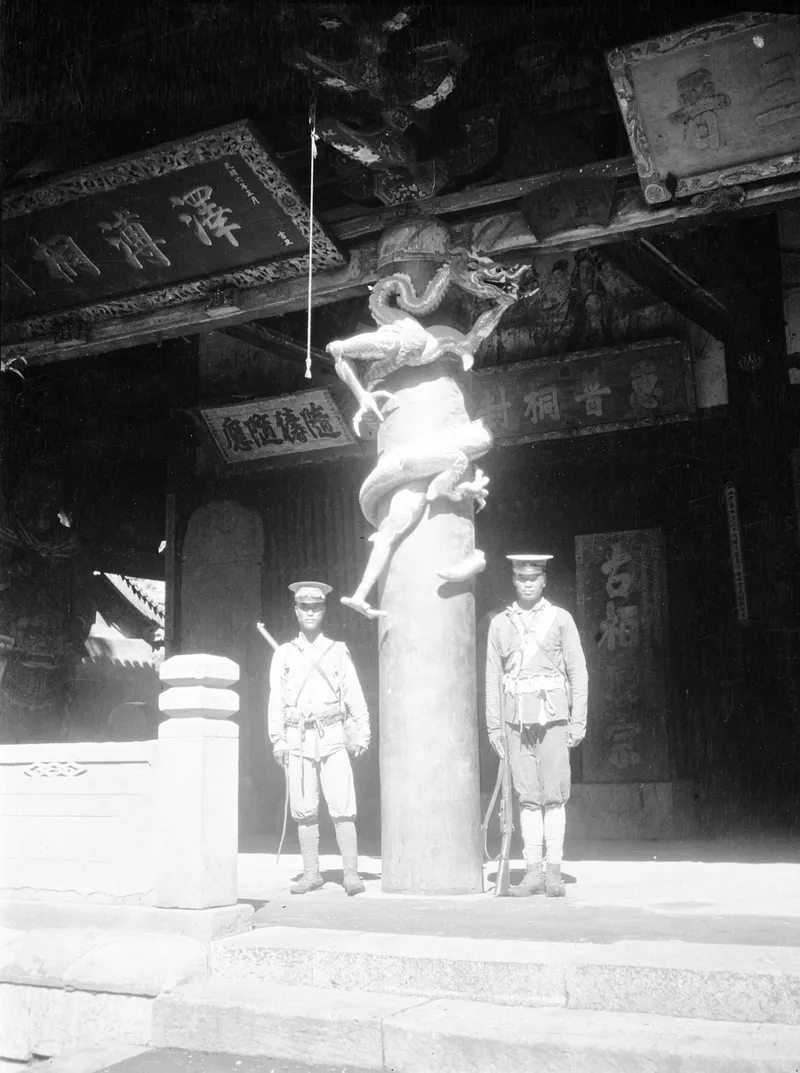
In the ninth year of Taiping Xingguo the court issued an edict to repair Jinci Temple, and the layout within began to change. During the Tiansheng era the Hall of the Sacred Mother was built at the source of the Jin River; before the hall eight pillars were coiled with golden dragons, “their heads all turned outward, pearls held in their mouths, gold and green interlaced, baring their fangs and brandishing their claws, seeming poised to take flight.” In the Xining era the governor of Taiyuan memorialized that the Sacred Mother enshrined in the hall “answered prayers at once, yet held no title”; the court conferred the title “Zhaoji Sacred Mother,” and the temple tablet too was a Song bestowal. From then on this shrine, first established to commemorate Tang Shuyu, was robbed of its center by the later-rising Hall of the Sacred Mother — the shrine’s name unchanged, its principal deity replaced.
Who was the Sacred Mother that was enshrined? The rain-thanking stele of the fifth year of Xuanhe of the Song states, “It was the Sacred Mother who gave rise to the auspice and laid the foundation of the house of Jin; with the graph in her hand, her divinity may be known” — the “graph in the hand” refers to the account in the Zuo Zhuan that when Tang Shuyu was born the lines on his palm formed the character “Yu,” and the only mother who could found the house of Jin was Yi Jiang. In the early Qing, Yan Ruoqu systematically examined the fragmentary steles and concluded that the Sacred Mother was Yi Jiang, mother of Tang Shuyu and daughter of Grand Duke Jiang, noting that “to the side stands the shrine of Tang Shuyu, facing south — here the son yields to the mother.” Shuyu was enfeoffed at Tang and founded Jin; the Jin River rose within his fief, and the folk attributed the founding of Jin to the mother who received the mandate in a dream, first raising a Maiden’s Shrine and then, because her prayers for rain proved efficacious, gradually adding titles; the halls grew ever grander, until at last the guest usurped the host. Yan Ruoqu regarded this as “an error in the canon of sacrifices,” but the pattern of the mother displacing the son continues to this day.
Historical Documents
Shuijing Zhu: The Jin River
晋水出晋阳县西悬瓮山。
The Jin River rises from Mount Xuanweng, west of Jinyang county.
县,故唐国也。春秋左传称,唐叔未生,其母邑姜梦帝谓己曰:余名而子曰虞,将与之唐,属之参。及生,名之曰虞。吕氏春秋曰:叔虞与成王居,王援桐叶为珪,以授之,曰:吾以此封汝。虞以告周公,周公请曰:天子封虞乎?王曰:余戏耳。公曰:天子无戏言。时唐灭,乃封之于唐。县有晋水,后改名为晋。故子夏叙诗称此晋也,而谓之唐,俭而用礼,有尧之遗风也。晋书地道记及十三州志并言晋水出龙山,一名结绌山,在县西北,非也。山海经曰:悬瓮之山,晋水出焉。今在县之西南。昔智伯之遏晋水以灌晋阳,其川上溯,后人踵其遗迹,蓄以为沼。沼西际山枕水,有唐叔虞祠,水侧有凉堂,结飞梁于水上,左右杂树交荫,希见曦景,至有淫朋密友,羁游宦子,莫不寻梁契集,用相娱慰,于晋川之中,最为胜处。
The county was the former state of Tang. The Zuo Zhuan of the Spring and Autumn Annals says that before Tang Shuyu was born, his mother Yi Jiang dreamed that the Lord on High said to her, “I name your son Yu; I shall give him Tang and assign him to the constellation Shen.” When he was born, he was named Yu. The Lüshi Chunqiu says: Shuyu was dwelling with King Cheng, and the king took a paulownia leaf and cut it into a jade tablet, handing it to him and saying, “With this I enfeoff you.” Yu reported this to the Duke of Zhou, who came and asked, “Has the Son of Heaven enfeoffed Yu?” The king said, “I was only jesting.” The duke said, “The Son of Heaven does not speak in jest.” At that time Tang had been destroyed, and so he was enfeoffed at Tang. The county had the Jin River, and its name was later changed to Jin. Thus Zixia, prefacing the Odes, called this “Jin” though it was named “Tang,” frugal yet observing ritual, retaining the surviving manner of Yao. The Didao Ji of the Jinshu and the Shisanzhou Zhi both say the Jin River rises from Mount Long, also called Mount Jiechu, northwest of the county — this is wrong. The Shanhai Jing says: from Mount Xuanweng the Jin River issues forth. It now lies southwest of the county. Long ago Zhi Bo dammed the Jin River to flood Jinyang, and the stream ran upward; later men followed his old traces and stored the water into a pool. On the west bank of the pool the mountain rises above the water, and there stands the Shrine of Tang Shuyu; beside the water is a cool hall, with a flying bridge spanning the stream, and mingled trees cast their shade on either side so that the sunlight is rarely seen. There are even wanton companions and intimate friends, and officials sojourning far from home, none of whom fail to seek out the bridge and gather there to divert and console one another — in all the land of Jin, it is the finest spot.
Yuanhe Junxian Zhi: Taiyuan Prefecture
晋祠,一名王祠,周唐叔虞祠也,在县西南十二里。
Jinci Temple, also called the Royal Shrine, is the shrine of Tang Shuyu of Zhou; it lies twelve li southwest of the county.
水经注曰:“昔智伯遏晋水以灌晋阳,其川上溯,后人蓄以为沼。”沼西际山枕水,有唐叔虞祠。水侧有凉堂,结飞梁于水上,晋川之中,最为胜处。
The Shuijing Zhu says: “Long ago Zhi Bo dammed the Jin River to flood Jinyang, and the stream ran upward; later men stored the water into a pool.” On the west bank of the pool the mountain rises above the water, and there stands the Shrine of Tang Shuyu. Beside the water is a cool hall, with a flying bridge spanning the stream — in all the land of Jin, it is the finest spot.
序行记曰:“高洋天保中,大起楼观,穿筑池塘,自洋以下,皆游集焉。”至今为北都之胜。
The Xu Xing Ji says: “In the Tianbao era of Gao Yang, towers and pavilions were raised on a grand scale and ponds were dug; from Gao Yang downward, all came to gather and roam there.” To this day it remains a scenic marvel of the Northern Capital.
Inscription and Preface for the Shrine of Jin
晋祠之铭,御制御书。夫兴邦建国,资懿亲以作辅;分圭锡社,寔茂德之攸居。非亲无以隆基,非德无以𢓜化。是知功侔分陕,奕叶之庆弥彰;道洽留棠,传芳之迹斯在。惟神诞灵周室,降德酆都,疏派天䵃,分枝璇极,经仁纬义,履顺居贞,揭日月以为躬,丽高明之质,括沧溟而为量,体弘润之资。德乃民宗,望惟国范,故能协隆鼎祚,赞七百之洪基;光启维城,开一匡之霸业。既而今古革运,舟壑潜迁,虽地尽三分,而余风未泯;世移千祀,而切烈犹存。玄化旷而无名,神理幽而靡究。故歆祠利祷,若存若亡,济世匡民,如显如晦。临汾川而降祉,櫿仁智以栖神。金阙九层,鄙蓬莱之已陋;玉楼千仞,耻昆闾之非奇。落月低于桂筵,流星起于珠树。若夫崇山亘时,作镇未墟,襟带边亭,标临朔土。悬崖百丈,弊日亏红;绝岭万寻,横天耸翠。霞无机而散锦,峰非水而开莲。石镜流辉,孤岩霄朗,松萝曳影,重溪昼昏。碧雾紫烟,郁古今之色;宦霜绛雪,皎冬夏之光。其施惠也则和风。溽露是生,油云有雨斯起。其至仁也,则霓裳鹤盖息焉,飞禽走兽依焉。其刚节也,则治乱不改其形,寒暑莫移其拯;其大量也,则育万物而不倦,资四方而靡穷。故以众美攸归,明抵是宅。岂如罗浮之岛,拔岭南迁,舞阳之山,移基北转。以夫挺秀之质,而无居常之资,故知灵岳标奇,托神威而为固。加以飞泉涌砌,激石分湍,萦氛雾而终清,有英俊之贞撡;住方圆以成像,体圣贤之屈伸。日注不穷,类芳猷之无绝;年倾不溢,同上德之诫盈。阴涧怀冰,春留冬镜;阳岩引溜,冬结春苔。非疏勒之可方,岂瀑布之能拟。
The Inscription for the Shrine of Jin, imperially composed and imperially written. Now, in raising a realm and founding a state, one relies on virtuous kin to serve as support; in dividing the jade and granting altars of the soil, it is abundant virtue that provides the dwelling. Without kin there is no way to exalt the foundation; without virtue there is no way to spread the transformation. Thus we know that when merit equals the division of Shan, the blessings of successive generations grow ever more manifest; when the Way is as full as the sweet-pear left behind, the traces of transmitted fragrance abide here. The divine spirit was born in the house of Zhou and descended her virtue upon Fengdu, branching from the heavenly stream and dividing from the jade axis; she wove benevolence and righteousness, trod in accord and dwelt in constancy, raised the sun and moon as her person, adorned with the substance of the lofty and bright, encompassed the vast seas as her measure, embodying the resource of breadth and depth. Her virtue was the ancestor of the people, her renown the model of the state, and so she could join in exalting the throne and further the mighty foundation of seven hundred years; she gloriously opened the protecting city and inaugurated the hegemonic enterprise of setting all to rights. Then, as past and present shifted their cycles and the boat within the ravine silently moved away, though the land was fully divided in three, her lingering influence was not extinguished; though the age had passed through a thousand years of sacrifice, her ardent legacy still endured. The mysterious transformation is vast and nameless, the divine principle deep and unfathomable. And so the offerings and beneficial prayers seem now present, now vanished; the saving of the age and the ordering of the people seem now revealed, now hidden. Descending blessings upon the River Fen, she rested her divinity upon benevolence and wisdom. The golden gate-towers of nine tiers disdain Penglai as already too mean; the jade towers of a thousand ren are ashamed that Kunlun’s gate is no marvel. The setting moon sinks below the cassia mats; shooting stars rise from the pearl trees. As for the lofty mountain that spans the ages, standing guard and never falling to ruin, girdling the border pavilions and marking the northern land: cliffs of a hundred zhang veil the sun and dim its red; sheer ridges of ten thousand ren stretch across the sky and rear their green. The rosy clouds scatter brocade without a loom; the peaks open lotuses though they be no water. The stone mirror sheds its light, the lone crag is bright against the heavens; the pine and creeper trail their shadows, and the layered streams turn day to dusk. Emerald mists and purple vapors gather the hues of ages past and present; frost of office and crimson snow shine with the light of winter and summer. In bestowing kindness there is the gentle breeze; the drenching dew is born of it, and the flowing clouds bring rain when it arises. In its utmost benevolence, the rainbow robes and crane canopies rest there, and flying birds and running beasts take refuge there. In its firm integrity, order and disorder cannot alter its form, nor cold and heat move its salvation; in its great capacity, it nourishes the myriad things without weariness and provides for the four directions without end. Thus, as all excellences converge upon it, this is manifestly its dwelling. How could it be like the isle of Luofu that uprooted its ridge and moved south, or the mountain of Wuyang that shifted its base and turned north? With such an outstanding substance yet no ordinary support, we know that the numinous peak marks its wonder and rests upon divine majesty for its firmness. Add to this the flying spring welling among the stone steps, dashing over rocks and dividing the rapids, winding through mist and vapor yet ever pure — it has the constant integrity of the eminent; taking form in square and round, it embodies the bending and extending of the sage and worthy. Pouring day upon day without exhaustion, it resembles a fine plan that never ceases; inclining year upon year without overflowing, it is one with the highest virtue’s caution against excess. The shaded ravine holds ice, keeping a winter mirror into spring; the sunlit crag draws its trickle, freezing in winter and mossy in spring. It is not to be matched with Shule, nor could any waterfall be compared to it.
至如浊泾清渭,岁岁同流;碧海黄河,时时一变。以夫括地之纪,横天之源,不能泽其常,莫能殊其撡。信乃兹泉表异,带仙宇而为珍,仰神居之肃清,想徽音其如在。是以朱轮华毂,接称于坛衢,玉币丰索,连箱于庙阕。氤氲灵气,仰之而弥高;昭晰神光,望之而逾肃。潜通固化,不爽于锱铢;感应明征,有逾于影响。惟贤是辅,非黍稷之为馨;唯德是依,岂筐篚之为惠。
As for the turbid Jing and clear Wei, they flow the same year after year; the emerald sea and the Yellow River change from time to time. Even the girdling record of the earth and the source that spans the heavens cannot make its constancy their favor, nor can any distinguish its integrity. Truly this spring marks a wonder, girding the immortal hall as a treasure; gazing up at the divine dwelling so pure and solemn, one imagines her lovely presence as if she were here. And so vermilion wheels and splendid hubs press one after another on the paths to the altar, and jade offerings abundantly sought line their chests up to the temple gate. The dense numinous vapor grows the higher the more one looks up; the clear divine radiance grows the more solemn the more one gazes upon it. Its hidden penetration and firm transformation do not err by a hair’s breadth; the clear signs of its response surpass even shadow and echo. Only the worthy does it support — it is not millet that is its fragrance; only virtue does it rely upon — how could baskets of offering be its kindness?
昔有随昏季,缙纪崩沦,四海腾波,三光藏曜。先皇袭千龄之徽号,膺八百之先期,用竭诚心,以祈家福。爰初鞠旅,发迹神祠,举风电以长驱,宠天地而遐掩。一戎大定,六合为家。虽膺箓受图,彰于天命,而克昌洪业,寔赖神功。
Of old, in the dark last years of the Sui, when the bonds of governance collapsed and sank, the seas within surged with waves and the three lights hid their brilliance. The former Emperor took up the noble title of a thousand ages and answered the appointed hour of eight hundred years; with utmost sincerity of heart he prayed for the blessing of his house. When he first marshaled his troops, he set out from the divine shrine, raising wind and lightning to drive far ahead, favored by Heaven and Earth to cover the distance. With a single campaign the great settlement was won, and the six directions became one household. Though he received the charts and registers, made manifest in the Mandate of Heaven, yet in being able to flourish the mighty enterprise, he truly relied upon divine merit.
故知茫茫万顷,必俟云雨之泽;巍巍五岳,必乃尘壤之资。虽九栋登年,由乎播种;千寻耸日,本藉崇基。然则不雨不云,则有炎枯之害;非尘非壤,则有倾覆之忧。虽立本于自然,亦成功而假助,岂大宝之独运,不资于灵福者乎?故无言不酬,无德不报,所以巡往迹,赛洪恩,临汾水而濯心,仰灵坛而肃志。
Thus we know that the boundless ten thousand acres must await the favor of cloud and rain; the towering Five Marchmounts must rely on the substance of dust and soil. Though the nine-beamed hall rises with the years, it comes from the sowing of seed; though a thousand ren tower toward the sun, they rest upon a lofty foundation. Then without rain and cloud there is the harm of scorching drought; without dust and soil there is the peril of collapse. Though rooted in nature, success too borrows aid — how could the great treasure move alone, without relying on numinous blessing? Therefore no word goes unrequited, no virtue unrepaid, and so I tour the old traces, repay the vast grace, come to the River Fen to cleanse my heart, and gaze up at the numinous altar to compose my will.
若夫照车十二,连城三五,币帛云委,珍羞山积,此乃庸鄙是享,恐非明神所歆。正当竭丽水之金,勒芳猷于不朽;尽荆山之玉,镌美德于无穷。召彼雨师,见兹惠泽,命斯风伯,扬此清尘。使地秪仰德于金门,山灵受化于固阙,括九仙而警卫,拥百神以前驱,俾洪威振于六幽,令誉光于千载。岂若高唐之庙,空号朝云,陈仓之祠,虚传夜影。式刊芳烈,乃作铭曰:
As for the twelve pearls that light a carriage and the three or five that are worth linked cities, the silks piled like clouds and the delicacies heaped like mountains — these are what the vulgar and mean would offer, and I fear they are not what the enlightened spirit savors. What is fitting is to exhaust the gold of the Li River and engrave a fine legacy for the imperishable; to use up all the jade of Mount Jing and carve fair virtue for the endless. Summon that Master of Rain to behold this beneficent favor; command this Earl of Wind to sweep away this pure dust. Let the earth-spirit look up in virtue at the golden gate and the mountain-spirit receive transformation at the firm portal, gathering the Nine Immortals as guards and marshaling the Hundred Spirits as vanguard, so that the vast majesty shakes the six shades and the fair renown shines for a thousand years. How could it be like the temple of Gaotang, vainly named for its morning clouds, or the shrine of Chencang, emptily said to hold night shadows? Duly to record her fragrant valor, I compose this inscription, saying:
赫赫宗周,明明哲辅。诞灵降德,承文继武。启庆留名,翦桐颁土。逸翮孤映,清飙自举。藩屏维宁,邦家攸序。传晖竹帛,降灵没晋。惟德是辅,惟贤是顺。不罚而威,不言而信。玄化潜流,洪恩遐振。沉沉清庙,肃肃灵切。松低羽盖,云挂仙冠。雾筵霄碧,霞帐晨丹。户花冬桂,连芳夏兰。代移神久,地古林残。泉涌端萦,泻砌分庭。非搅可浊,非澄自清。地斜文直,涧曲流平。翻霞散锦,倒日澄明。冰开一镜,风激千声。既瞻清洁,载想忠贞。濯兹尘秽,莹此心灵。猗欤胜地,伟哉灵异。日月有穷,英声不匮。天地可极,神威靡坠。万代千龄,芳猷永嗣。
Resplendent was the royal Zhou, brilliant its wise supports. She bore the divine and sent down virtue, succeeding King Wen and continuing King Wu. She opened blessings and left a name; the paulownia was cut and lands were granted. The soaring pinion casts its lone reflection; the pure gale rises of itself. The protecting screen is at peace, the realm and house in order. Her radiance is handed down on bamboo and silk; her spirit descended and merged with Jin. Only virtue does she support, only the worthy does she favor. Without punishing she is awesome, without speaking she is trusted. The mysterious transformation flows in secret; the vast grace resounds afar. Deep, deep, the pure temple; solemn, solemn, its numinous force. The pines droop like feathered canopies; the clouds hang like immortal crowns. Misted mats of azure sky, rosy curtains of morning cinnabar. Cassia flowers at the door in winter, orchids in fragrant rows in summer. Ages have shifted, the spirit is ancient; the land is old, the woods worn away. The spring wells up and winds around, pouring over the steps and dividing the court. It cannot be stirred to turbidity, nor need it settle to become clear. Where the ground slants its pattern runs straight; where the ravine bends its flow lies level. It turns the rosy clouds and scatters brocade, reflects the inverted sun in limpid brightness. When ice breaks, it is a single mirror; when wind stirs, a thousand sounds. Having beheld its purity, one contemplates loyalty and constancy. It washes away this dust and filth and brightens this heart and soul. Ah, what a scenic place; how great its numinous wonder! The sun and moon may have their end, but her fine fame is never wanting. Heaven and earth may reach their limit, but her divine majesty never falls. For ten thousand ages and a thousand years, her fine legacy shall be inherited forever.
贞观廿年正月廿六日。
The twenty-sixth day of the first month of the twentieth year of Zhenguan.
Note on the Jinci Rain-Thanking Stele
桉:通志金石记:宋谭稹祭汾东王庙文,宣和五年,姜仲谦撰,赵令畤行书。今拓本维宣和五年五月初七日己未,起复太尉、武信军节度使云云,致祭于显灵昭济圣母汾东王之祠,有云:访往古之丛祠,考故事于丰碑。惟圣母之发祥,肇晋室而开基,有文在手,神灵可知。是谓圣母为邑姜也。
Note: The Tongzhi Jinshi Ji records the sacrificial text by Tan Zhen of the Song for the temple of the Prince of Fendong, composed by Jiang Zhongqian in the fifth year of Xuanhe, in the running script of Zhao Lingzhi. The present rubbing reads: on the seventh day, jiwei, of the fifth month of the fifth year of Xuanhe, the Grand Commandant recalled to office and Military Commissioner of the Wuxin Army, and so forth, offered sacrifice at the shrine of the manifestly efficacious Zhaoji Sacred Mother, Prince of Fendong. It says: seeking out the ancient cluster of shrines, examining the old affairs on the great stele — it was the Sacred Mother who gave rise to the auspice and laid the foundation of the house of Jin; with the graph in her hand, her divinity may be known. This means the Sacred Mother is Yi Jiang.
太原县志:晋源神祠在晋祠,祀叔虞之母邑姜,宋天圣间建。熙宁中以祷雨应,加号昭济圣母。引国朝阎若璩说,定为邑姜。所云访得宋宣和五年残碑姜仲谦谢雨文者,即此碑。今志刻本讹作政和。
The Taiyuan Xian Zhi: the Jinyuan Shrine stands at Jinci, enshrining Yi Jiang, mother of Shuyu, built during the Tiansheng era of the Song. In the Xining era, because her prayers for rain proved efficacious, she was given the added title of Zhaoji Sacred Mother. Citing the account of Yan Ruoqu of this dynasty, it is fixed as Yi Jiang. What is said about the fragmentary stele of the fifth year of Xuanhe of the Song bearing Jiang Zhongqian’s rain-thanking text is this very stele. The present printed edition of the gazetteer wrongly gives it as the Zhenghe era.
Jinshi Lu: Tang Stele Inscription of Jinci
右唐晋祠铭,太宗撰并书。晋祠者,唐叔虞祠也。高祖初,起兵祷于叔虞祠。至贞观二十年,太宗为立碑。
The above is the Tang Inscription of Jinci, composed and written by Taizong. Jinci is the shrine of Tang Shuyu. When Gaozu first raised his troops, he prayed at the shrine of Shuyu. By the twentieth year of Zhenguan, Taizong set up a stele there.
Jinci Rain-Thanking Text
维宣和五年岁次癸卯五月癸丑朔七日已未,河东、燕山府路宣抚使谭祯谨以清酌庶羞之奠,致祭于显灵昭济圣母汾东王之祠。兹衔命而出使兮,总燕晋之抚绥。并并州之故垒兮,访往古之丛祠。乃乘传而修谒兮,历山路之透迤。询遗迹于父老兮,曰祸福惟神之所司。属常旸之稍愆兮,渴霈泽之甘祁。虽地偏而节晚兮,惧南亩之失时。念密云之或布兮,久屯膏而未施。顾无路以讼风伯兮,又力不能鞭夫雷师。乃潜心而默祷兮,薄精神之上驰。达龙香之芬苾兮,耸冠佩之陆离。
On the seventh day, jiwei, of the fifth month, which began on the guichou day, of the fifth year of Xuanhe, the year guimao, Tan Zhen, Pacification Commissioner of the Hedong and Yanshan circuits, respectfully with an offering of clear libation and sundry viands offers sacrifice at the shrine of the manifestly efficacious Zhaoji Sacred Mother, Prince of Fendong. Charged with a commission I set out on my mission, overseeing the pacification of Yan and Jin. Passing the old ramparts of Bingzhou, I sought out the ancient cluster of shrines. Riding the post-carriage I paid my respects, traversing the winding mountain roads. Inquiring of the elders about the old traces, they said that fortune and misfortune are what the spirit governs. It happened that the constant sunshine had somewhat erred, and I thirsted for the sweet plea of a drenching rain. Though the land was remote and the season late, I feared the southern fields would miss their time. Thinking that the dense clouds might spread, they had long withheld their richness and not yet bestowed it. I saw no way to sue the Earl of Wind, and my strength could not whip the Master of Thunder. So I stilled my heart and prayed in silence, and my slight spirit raced upward. It reached the fragrance of the dragon-incense, and the crowned pendants rose glittering.
步长廊之回环兮,考故事于丰碑。惟圣母之发祥兮,肇晋室而开基。王有文之在手兮,其神灵之可知。顾林薄之映带兮,发岩岫之英奇。泉出于堂下兮,作万顷之宏陂。信灵仙之窟宅兮,宜庙食之在兹。矧归禾之盛德兮,惠故土而不疑。曾未逾于浃辰兮,遂渗漉于灵厘。初霡霖而裛尘兮,欻檐溜之已垂。散郁结为欢愉兮,回清润于赫曦。谅挟才于大泽兮,起高卧之潜螭。何作霖于肤寸兮,被远近而不遗。麦酣酣而将秀兮,万绿净其纷披。助朱明之长养兮,验丰年之可期。惟灵鉴之盛昭兮,实大庇于黔黎。念何以报贶兮,乃诹日而灼龟。奠葡萄之佳酿兮,奉蕴藻以荐词。冀明灵之终惠兮,盛百谷之如茨。惟菲薄之是媿兮,惟神听之无私。伏惟尚飨。
Pacing the winding of the long gallery, I examined the old affairs on the great stele. It was the Sacred Mother who gave rise to the auspice and laid the foundation of the house of Jin. Since the prince had the graph in his hand, her divinity may be known. I looked upon the groves and thickets set off against each other, and the crags and peaks giving forth their splendor. A spring issues below the hall, forming a vast pool of ten thousand acres. Truly this is the abode of the numinous immortal, and fitting that her temple offerings should be here. How much more, with the abundant virtue of the returning grain, does she bless her old land without doubt. Before a full cycle of twelve days had passed, the numinous moisture seeped and soaked through. First a fine drizzle laid the dust, and suddenly the eaves already dripped. It dispelled what was pent up into joy and turned pure moisture back upon the blazing sun. Surely, harboring its power in the great marsh, the hidden hornless dragon rose from its lofty repose. How, making rain from an inch of cloud, it covered far and near and left nothing out. The wheat grew lush and ripe, about to ear, its ten thousand greens spread pure and profuse. It aids the long nurturing of high summer and proves that a bountiful year may be looked for. It is the numinous mirror shining forth in abundance that truly gives great shelter to the common folk. Thinking how to repay the gift, I chose a day and burned the tortoise. I set out the fine vintage of grapes and offered water-plants with my presented words. I hope the enlightened spirit will grant her favor to the end, that the hundred grains may pile up like thatch. I am ashamed of my meager offering, but the spirit’s hearing is without partiality. I humbly pray she may partake.
Taiyuan Xian Zhi: Shrines and Temples
晋源神祠在晋祠,祀叔虞之母邑姜。宋天圣间建。熙宁中,以祷雨应,加号昭济圣母。崇宁初,敕重建。元至正二年重修。明洪武初,复加号广惠显灵昭济圣母。四年,改号晋源之神。天顺五年,按院茂彪重修,岁以七月二日致祭。
The Jinyuan Shrine stands at Jinci, enshrining Yi Jiang, mother of Shuyu. It was built during the Tiansheng era of the Song. In the Xining era, because her prayers for rain proved efficacious, she was given the added title of Zhaoji Sacred Mother. In the early Chongning era it was rebuilt by edict. In the second year of Zhizheng of the Yuan it was repaired. In the early Hongwu era of the Ming she was again given the added title of Guanghui Xianling Zhaoji Sacred Mother. In the fourth year the title was changed to the Spirit of Jinyuan. In the fifth year of Tianshun, the Regional Inspector Mao Biao repaired it, and sacrifice was offered yearly on the second day of the seventh month.
阎若璩曰:邑姜为十乱之一,齐太公望女,唐叔虞母,叔虞之封唐也,亦发梦于其母,故今晋水源有女郎祠,实邑姜之庙。旁方为唐叔虞庙,南向,此子为母屈者也。母封曰圣母,子封日汾东,正祀典之讹。自明洪武四年,诏革天下神祇封号,止称以山水本名,于是圣母庙改而为晋源神祠矣。当时礼官不学如此。余从草间搜出宋政和五年残碑,乃姜仲谦谢雨文,首云致祭于显灵昭济圣母汾东王之祠,中云:惟圣母之发祥兮,肇晋室而开基;王有文之在手兮,其神灵之可知。喜得一典,证属有司,当上闻于朝,以厘正之,而别建晋源神祠。又日女郎祠之建,实始于天圣,而封号之加,则自熙宁祷应始宣和五年,上距天圣甫百年,其建祠之故与所祠之人,必历历有据,故仲谦得之于传闻,而载之于撰著。不然,岂牵合傅会遂至此也。
Yan Ruoqu says: Yi Jiang was one of the ten capable ministers, daughter of Grand Duke Wang of Qi and mother of Tang Shuyu. When Shuyu was enfeoffed at Tang, it too was foretold in a dream to his mother; hence today at the source of the Jin River there is a Maiden’s Shrine, which is truly the temple of Yi Jiang. To the side stands the temple of Tang Shuyu, facing south — here the son yields to the mother. The mother’s title is Sacred Mother, the son’s title Fendong — this is precisely an error in the canon of sacrifices. From the fourth year of Hongwu of the Ming, an edict abolished the titles of the spirits of the empire, calling them only by the original names of their mountains and waters, and so the temple of the Sacred Mother was changed into the Jinyuan Shrine. So unlearned were the ritual officials of that time. I searched out from among the weeds a fragmentary stele of the fifth year of Zhenghe of the Song, which is Jiang Zhongqian’s rain-thanking text; it begins by saying that sacrifice was offered at the shrine of the manifestly efficacious Zhaoji Sacred Mother, Prince of Fendong, and in the middle says: it was the Sacred Mother who gave rise to the auspice and laid the foundation of the house of Jin; since the prince had the graph in his hand, her divinity may be known. I was glad to obtain this one source; it verifies the matter for the authorities, and it ought to be reported to the court to set it right and to build a separate Jinyuan Shrine. Moreover, the building of the Maiden’s Shrine truly began in the Tiansheng era, while the addition of the title began with the efficacious prayers of the Xining era. The fifth year of Xuanhe is only a hundred years after Tiansheng; the reason for building the shrine and the person enshrined must have been recorded clearly, and so Zhongqian obtained it from tradition and set it down in his composition. Otherwise, how could such forced and far-fetched connections have come about?
Yongle Dadian: Temples
惠远庙即昭济圣母庙,在祠中,东向晋水源上,旧经谓之女郎祠。南有难老泉,北有善利泉,中有八角池,其泉溉田百顷。宋熙宁中,太原守臣奏:“晋祠庙内有圣母殿,虽图经不载,祈祷即应,未有封号,诚为阙典。”事下太常以闻,乃加号昭济圣母,有中书门下黄牒刻石宝墨堂中,庙额亦宋世所赐也。国朝洪武四年,改为晋源之神。
The Huiyuan Temple is the temple of the Zhaoji Sacred Mother, standing within the shrine, facing east above the source of the Jin River; the old gazetteer calls it the Maiden’s Shrine. To the south is the Nanlao Spring, to the north the Shanli Spring, and in the middle an octagonal pool whose water irrigates a hundred acres of fields. In the Xining era of the Song, the governor of Taiyuan memorialized: “Within the temple of Jinci there is a Hall of the Sacred Mother; though it is not recorded in the illustrated gazetteers, prayers to it are answered at once, yet it holds no title — this is truly a gap in the canon.” The matter was sent down to the Court of Imperial Sacrifices and reported, and she was given the added title of Zhaoji Sacred Mother; a yellow document of the Secretariat-Chancellery was engraved on stone in the Baomo Hall, and the temple tablet too was bestowed by the Song. In the fourth year of Hongwu of this dynasty, it was changed to the Spirit of Jinyuan.
Jinci Zhi: A Brief Account of Jinci
晋祠即唐叔虞祠也,今附祀于内之庙凡十有三:曰圣母殿,祀叔虞之母邑姜也。
Jinci is the shrine of Tang Shuyu. Today the temples enshrined together within it number thirteen in all: the first is the Hall of the Sacred Mother, enshrining Yi Jiang, mother of Shuyu.
Jinci Zhi: The Jinci Stele Inscription
唐贞观二十年春,太宗御制序文及铭并行书。文二十一行半,铭四行半,字多漫灭,下截尤甚。碑额贞观廿年正月廿六曰九字,系飞白书。石高丈许,广四尺,厚七寸,阴侧均有题名,上覆以亭,颜曰贞观宝翰,在唐叔虞祠东南隅,无所谓晋使。初邑志晋祠碑铭,贞观二十一年太宗御制碑文及铭,阴有唐臣衔名。大鹏案:碑额贞观廿年正月廿六日九字,而曝书亭集、铁函斋书跋、金石萃编皆言贞观二十一年七月八字,悉与碑额不符。所可异者,朱竹坨五过晋祠,亲摩唐碑,犹且有误,何况未到晋祠,仅据简编而言,目未亲见碑石,果何如书者乎?孟于曰:尽信书则不如无书。于斯概见。父老传言,唐碑凡戈字均虞世南代书者。乾隆年山西冀宁道徐浩游晋祠诗,有唐碑剥落虞戈在之句,则是碑间戈字皆为虞世南代书者似也。
In the spring of the twentieth year of Zhenguan of the Tang, Taizong imperially composed the preface and inscription and wrote them in running script. The text is twenty-one and a half lines, the inscription four and a half lines; many characters are worn away, the lower part especially so. The stele’s head bears the nine characters “the twenty-sixth day of the first month of the twentieth year of Zhenguan” in flying-white script. The stone is over a zhang high, four chi wide, and seven cun thick, with signatures on both the back and the sides, sheltered above by a pavilion titled “Zhenguan Baohan,” standing at the southeast corner of the Shrine of Tang Shuyu — there is no so-called Jin envoy. Earlier, the county gazetteer’s account of the Jinci stele inscription said that in the twenty-first year of Zhenguan Taizong imperially composed the stele text and inscription, with the names of Tang officials on the back. Dapeng notes: the stele’s head bears the nine characters “the twenty-sixth day of the first month of the twentieth year of Zhenguan,” yet the Pushu Ting Ji, the Tiehanzhai Shuba, and the Jinshi Cuibian all give the eight characters “the seventh month of the twenty-first year of Zhenguan,” none of which agree with the stele’s head. What is strange is that Zhu Zhutuo passed through Jinci five times and personally examined the Tang stele, yet still erred — how much more those who never came to Jinci and spoke only from brief records, having never seen the stele with their own eyes; what sort of writers are they indeed? Mencius said: to trust the text entirely is worse than having no text. This can be seen clearly here. The elders say by tradition that on the Tang stele every “ge” character was written on Taizong’s behalf by Yu Shinan. In a Qianlong-era poem by Xu Hao, Jining Circuit Intendant of Shanxi, on visiting Jinci, there is the line “the Tang stele flakes away, but Yu’s ge remains” — it seems, then, that the “ge” characters on the stele were all written on his behalf by Yu Shinan.
然考虑书,太宗于贞观十九年征辽返驾,十二月幸并州,二十年正月制文及铭,亲书于石,而世南巳于贞观十三年先卒,何尝有代书铭碑戈字之事?谓唐碑戈字,太宗得法于虞则可,谓戈字系世南代书,则不可。奥信矣。
But on careful examination of the records: Taizong returned from his campaign against Liao in the nineteenth year of Zhenguan, visited Bingzhou in the twelfth month, composed the text and inscription in the first month of the twentieth year, and wrote them himself on stone — yet Yu Shinan had already died earlier, in the thirteenth year of Zhenguan. How could there have been any matter of his writing the “ge” characters of the stele inscription on Taizong’s behalf? To say that in the “ge” characters of the Tang stele Taizong took his method from Yu is acceptable; to say that the “ge” characters were written on his behalf by Yu Shinan is not. This is truly to be believed.
Jinci Zhi: The New Pine Record Stele
唐宪宗元和元年立石。邑志云:新松记碑在晋祠。今碑与记沦胥以亡。
The stone was set up in the first year of Yuanhe under Emperor Xianzong of the Tang. The county gazetteer says: the New Pine Record stele stands at Jinci. Today both the stele and the record have perished together.
通志:晋祠新松记碑,元和元年,令狐楚撰记,颜颙书。见金石录。旧在太原县。
The Tongzhi: the New Pine Record stele of Jinci, of the first year of Yuanhe, with the record composed by Linghu Chu and written by Yan Yong. It is noted in the Jinshi Lu. It formerly stood in Taiyuan county.
Jinci Zhi: The Stele on Repairing Jinci
石高丈许,广可三尺,字皆剥落,可辨者无几。宋太宗太平兴国九年甲申丁丑朔,将仕郎、尚书职方员外赵昌言奉敕撰,翰林院待诏、中大夫、司农少卿赐绯鱼袋张仁庆书。在胜瀛楼北阶上。
The stone is over a zhang high and about three chi wide; the characters are all flaked away, and few can be made out. In the ninth year of Taiping Xingguo under Emperor Taizong of the Song, the year jiashen, the month beginning on the dingchou day, it was composed by imperial edict by Zhao Changyan, Court Gentleman for Ceremonial Service and Vice Director of the Bureau of Operations in the Department of State Affairs, and written by Zhang Renqing, Awaiting Instruction of the Hanlin Academy, Grand Master of the Palace, Vice Minister of the Court of the National Granaries, granted the crimson fish-pouch. It stands on the northern steps of the Shengying Tower.
Jinci Zhi: The Hall of the Sacred Mother
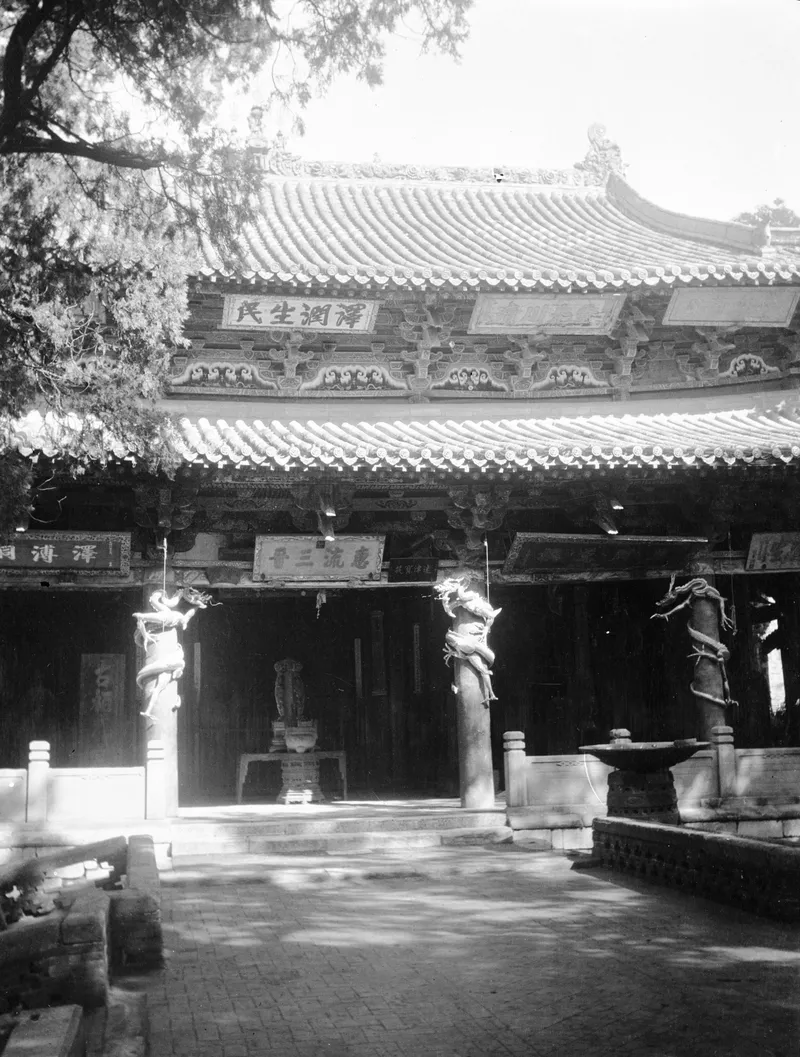
圣母殿,宋仁宗天圣间创建,位兑向震,初名女郎祠,继号晋源神祠,今名圣母庙。历代屡修,崇宏壮丽,独冠中居。有堂,有陛,槛皆白石,望之杰然。殿内妥广惠显灵昭济沛泽翊化圣母像。神厨有木质霹雳车二,形如圆月,边尽锋铓,若火焰向上。其下有座,高二尺许,传言行冰电所用。左右有站殿将军二,高各丈余,一形容雄壮,一象貌狰狞,均秉𫓧钺。其前八楹,佥蟠金螭,头皆向外,口内衔珠,悉属朱色,用彩金丝贯串,金碧相间,负柱萦绕,张牙舞爪,俨含飞动之状。东立沼滨,凭栏俯视,龙影倒印水中,随波漾涌,宛似活龙踊跃。乐平乔庄简公宇所谓殿前皆饰金龙于柱是也。
The Hall of the Sacred Mother was first built during the Tiansheng era under Emperor Renzong of the Song, sited in the dui position and facing the zhen direction; it was first named the Maiden’s Shrine, then titled the Jinyuan Shrine, and is now named the Temple of the Sacred Mother. Repaired again and again over the dynasties, lofty and magnificent, it stands foremost among all the halls. It has a hall and steps, its railings all of white stone, imposing to behold. Within the hall rests the image of the Sacred Mother, Guanghui Xianling Zhaoji Peize Yihua. In the divine kitchen are two wooden “thunderbolt carriages,” shaped like full moons, their edges all in points like flames rising upward. Beneath each is a base over two chi high, said by tradition to be used for producing ice and lightning. To the left and right stand two hall-guarding generals, each over a zhang high — one heroic and mighty in appearance, one fierce and terrible — both wielding battle-axes. Before them are eight pillars, each coiled with a golden hornless dragon, their heads all turned outward, pearls held in their mouths, all in vermilion, threaded with colored gold wire, gold and green interlaced, wound about the bearing pillars, baring their fangs and brandishing their claws, seeming poised to take flight. Standing on the east bank of the pool and leaning on the railing to gaze down, the dragons’ reflections are printed inverted in the water, rippling and surging with the waves, just as if living dragons were leaping. This is what Duke Qiao Zhuangjian of Leping meant by saying that before the hall golden dragons are all wrought upon the pillars.
Historical Photographs
1906–1909
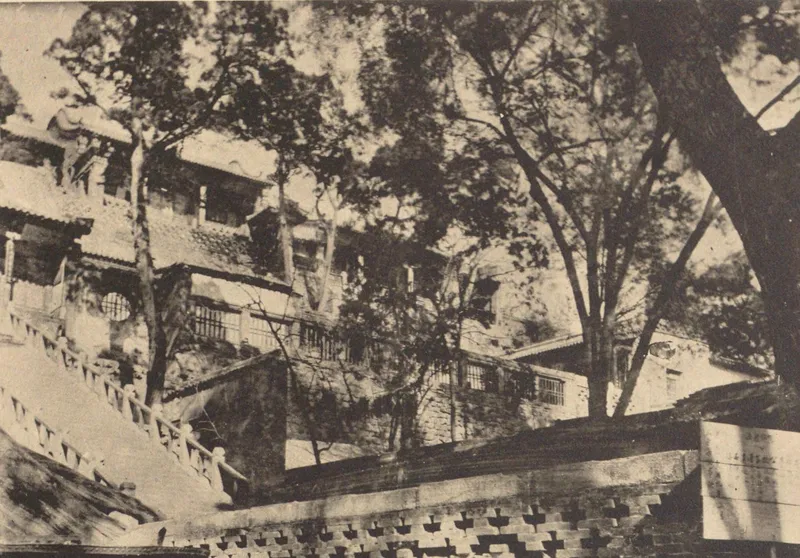
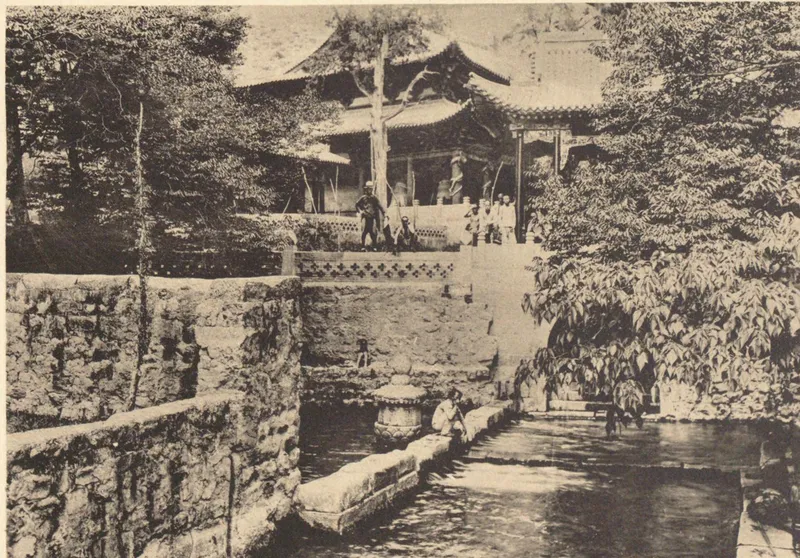
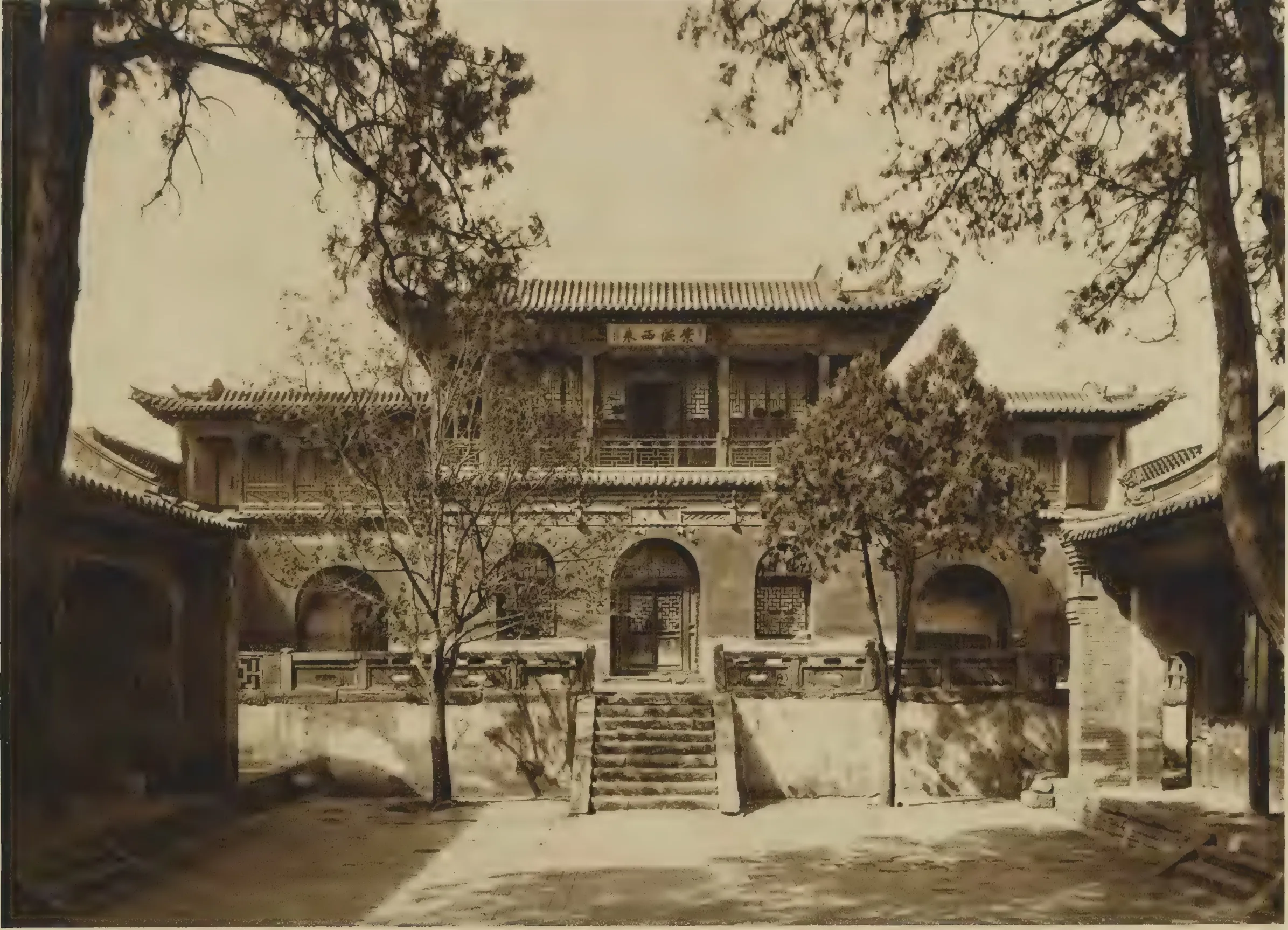
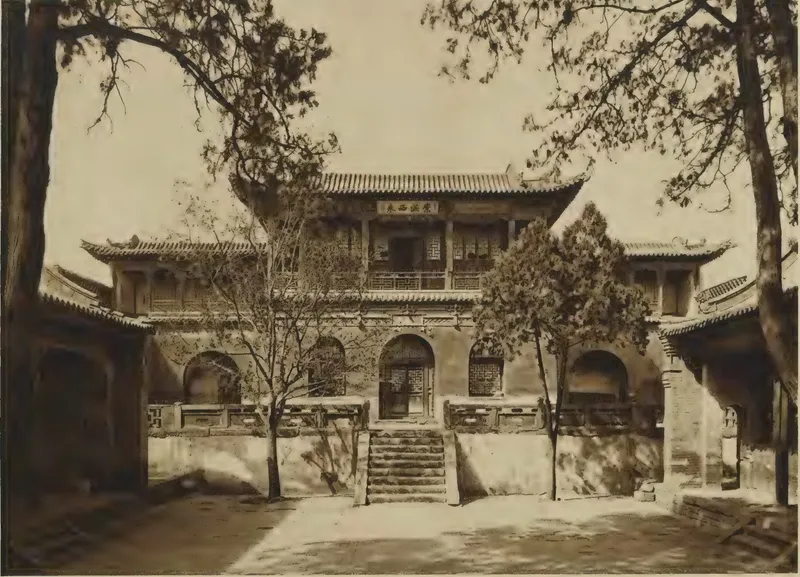
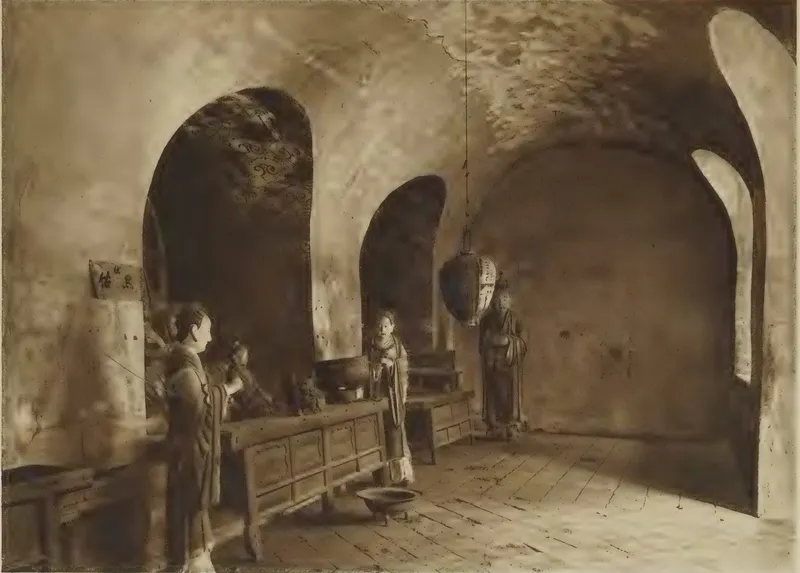
Photographed by the German architectural scholar Ernst Boerschmann during his survey of China and included in his Baukunst und Landschaft in China. The two old views record, respectively, the exterior of the principal hall of the Jinci temple complex and the ground-floor interior of the principal hall.
1914
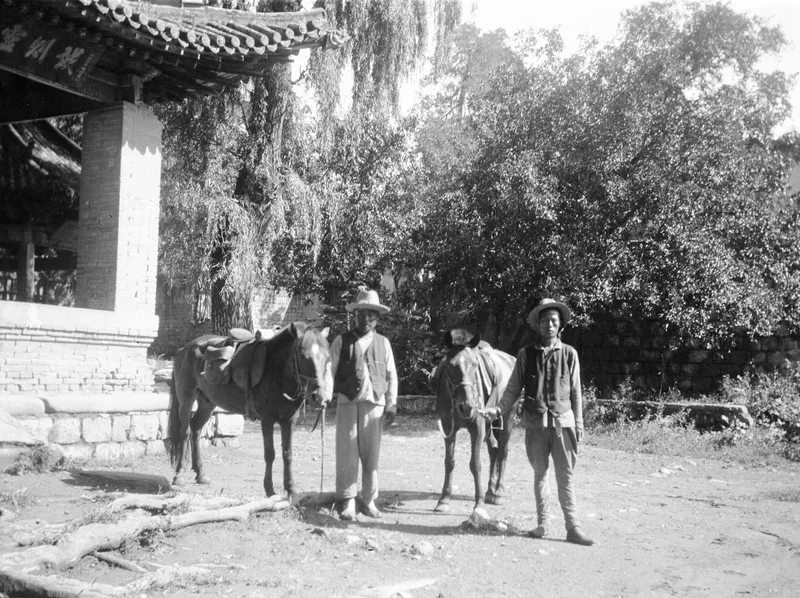
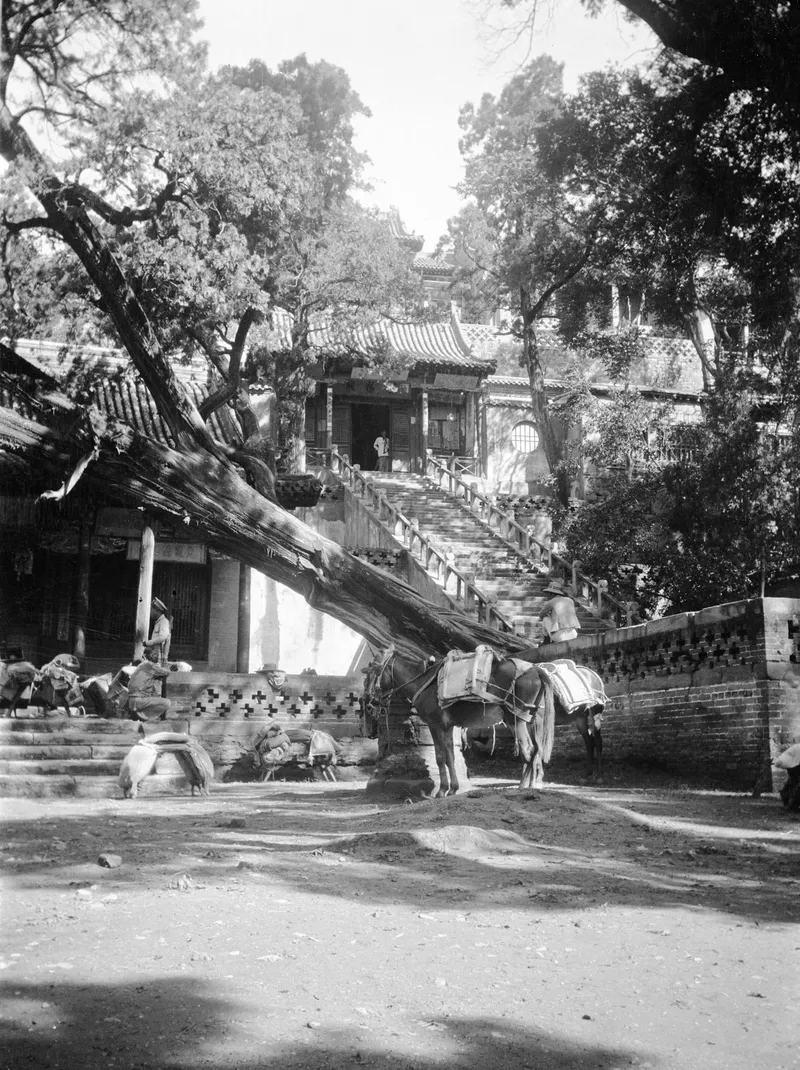
Photographed by the American geologist Frederick G. Clapp during his geological survey of northwestern China, now held by the University of Wisconsin–Milwaukee Libraries. The photographs record the entrance of Jinci, the front of the Hall of the Sacred Mother, the ancient trees before the hall, and visitors of the time.
1920s–1930s
Volume 8 of Tokiwa Daijō and Sekino Tadashi’s Historical Monuments of China includes old views of the guest hall and the spring source of Jinci.