Introduction
The date of Nanchan Temple’s main hall hangs on a single ink inscription on the underside of a beam. The inscription beneath the western four-rafter beam reads “following the old name, in the third year of Jianzhong of the Great Tang, the year renxu … the hall was renovated, Faxian and others respectfully record this.” The third year of Jianzhong is 782 CE, making this small hall in Lijia Village, Wutai County, one of the earliest surviving Tang-dynasty timber buildings with a definitive date.
The Qingliang Shan Zhi records that Emperor Daizong ordered the construction of a Manjusri hall on Mount Wutai, with bronze tiles and a statue one zhang six chi tall. This record does not point directly to the Nanchan Temple in Lijia Village, but it shows that around the time of Jianzhong 3, the Wutai Mountain area already had a background of Tang emperors building Manjusri-faith architecture. What truly pins down the hall itself is still that ink inscription — a single line nailing the building to its date.
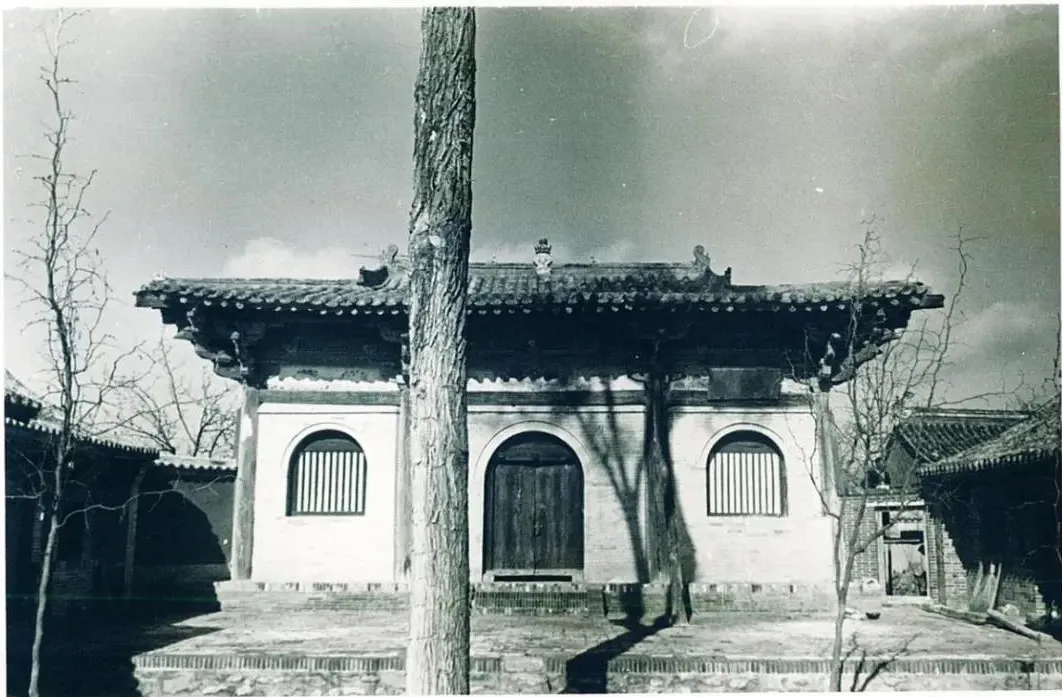
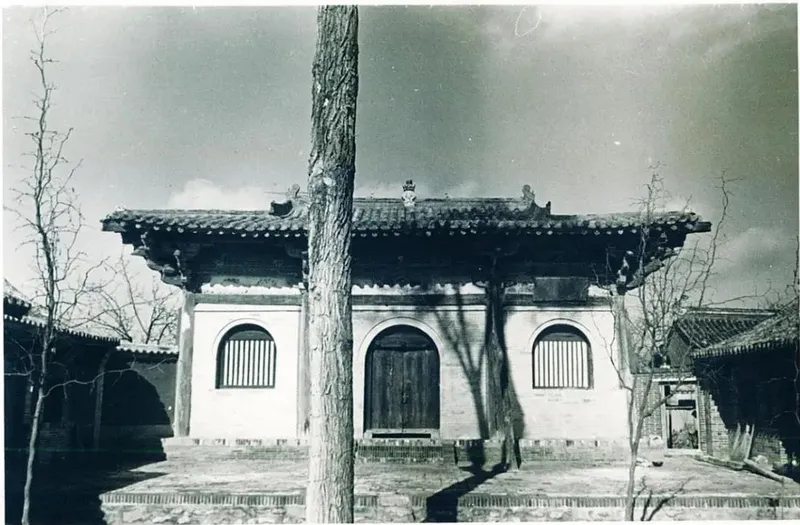
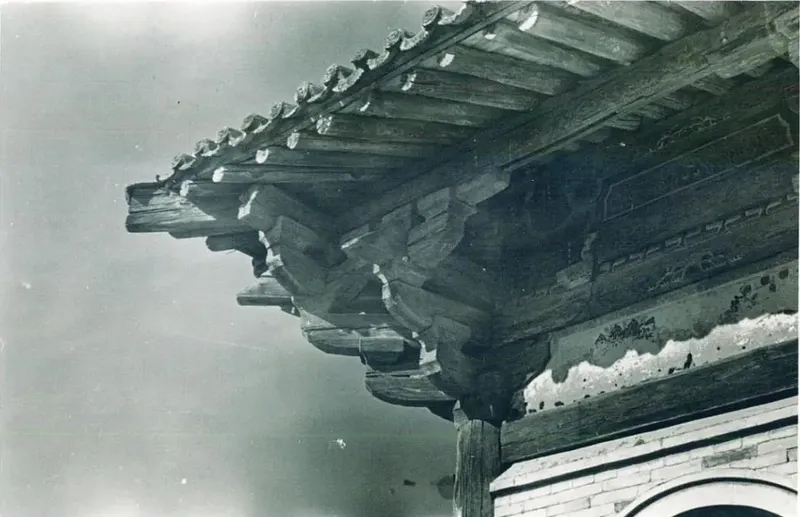
The 1953 survey photographs preserved the state before restoration: the front-eave doors and windows, the eave projections and structural details, captured in the lens in their last pre-restoration condition.
Historical Documents
Ink Inscription from the Third Year of Tang Jianzhong
因旧名峕大唐建中三年岁次壬戌月居戊申丙寅朔庚午日癸未时重修殿法显等谨志
Because of the old name: in the third year of Jianzhong of the Great Tang, in the year renxu, with the month under wushen, on the gengwu day after the bingyin new moon, at the guiwei hour, the hall was rebuilt. Faxian and others respectfully recorded this.
Construction of the Mount Wutai Manjusri Hall in Qingliangshan Zhi
代宗广德元年十一月,土番陷京师,帝在华阴,文殊现形,以狄语授帝。及郭子仪克复京师,驾还长安。诏修五台文殊殿,铸铜为瓦,造文殊像,高一丈六尺,镀金为饰。
In the eleventh month of the first year of the Guangde era of Emperor Daizong, the Tibetans captured the capital while the emperor was at Huayin. Manjusri appeared in bodily form and instructed the emperor in the language of the Di. When Guo Ziyi recovered the capital and the imperial carriage returned to Chang’an, an edict ordered the construction of the Manjusri Hall on Mount Wutai, with cast bronze used for its tiles and a Manjusri image made one zhang and six chi high, gilded as ornament.
Historical Photographs
1953
When the China Great Wall Heritage website republished Cha Qun’s “Comparative Study of Two Repair Plans for Nanchan Temple Main Hall,” it included 1953 survey photographs of the Main Hall, noting that they are held by the Chinese Academy of Cultural Heritage. The two images below have been cropped to remove webpage margins while preserving the photograph itself.
Related Sources
- Qi Yingtao, Preliminary Draft Repair Plan for Nanchan Temple Main Hall, 1950s.
- Qi Yingtao and Chai Zejun, “Repair of Nanchan Temple Main Hall”, Wenwu, 1980, no. 11.
- Chai Zejun, “Technical Report on the Repair Works of Nanchan Temple Main Hall”, Cultural Relics Conservation Technology, first series, 1981.
- Qi Yingtao and Chai Zejun, “Report on the Repair Project of Nanchan Temple Main Hall, Mount Wutai”, in Studies in Architectural History, first series, 1982.
- Cha Qun, “Comparative Study of Two Repair Plans for Nanchan Temple Main Hall”, China Cultural Heritage, 2018, no. 1.
- Zhang Rong, Wang Yizhen, Wang Qi, and Li Yumin, “Historical Context of Reconstruction, Modular Design System, and Statue Arrangement of Nanchansi Main Hall”, Journal of Architectural History, 2022, no. 2.
- Li Yuqun, “A Northern Wei Vajrasana Stone Pagoda Formerly Kept at Nanchan Temple on Mount Wutai”, Wenwu, 2008, no. 4.
- Cha Qun, “In Cultural Relic Repair, Research Runs Through the Whole Process”, People’s Daily, November 15, 2025, p. 8.