Introduction
Guangxiao Temple is the temple in the city of Guangzhou that changed its name and its masters most frequently. It began as the garden plot where Yu Fan of the Sun Wu lived in banishment, known to people as the Yu Garden, or Helin. The residence was later donated to become a temple, and from the Eastern Jin and Emperor Wu of the Liang down through the Tang and Song it received imperial patents in every generation. In the Yifeng era of the Tang, Huineng here debated the wind and the banner, was tonsured, and received the precepts; the temple entered the lineage of the Chan school under the name “Faxing Temple,” and Facai built the Hair-Burial Pagoda for him to enshrine the hair that had been shaved off. The names and identities kept changing, yet the physical objects within the temple — the hair pagoda, the iron pagodas, the bell — remained one by one, and became the tokens by which later generations recognized this temple.
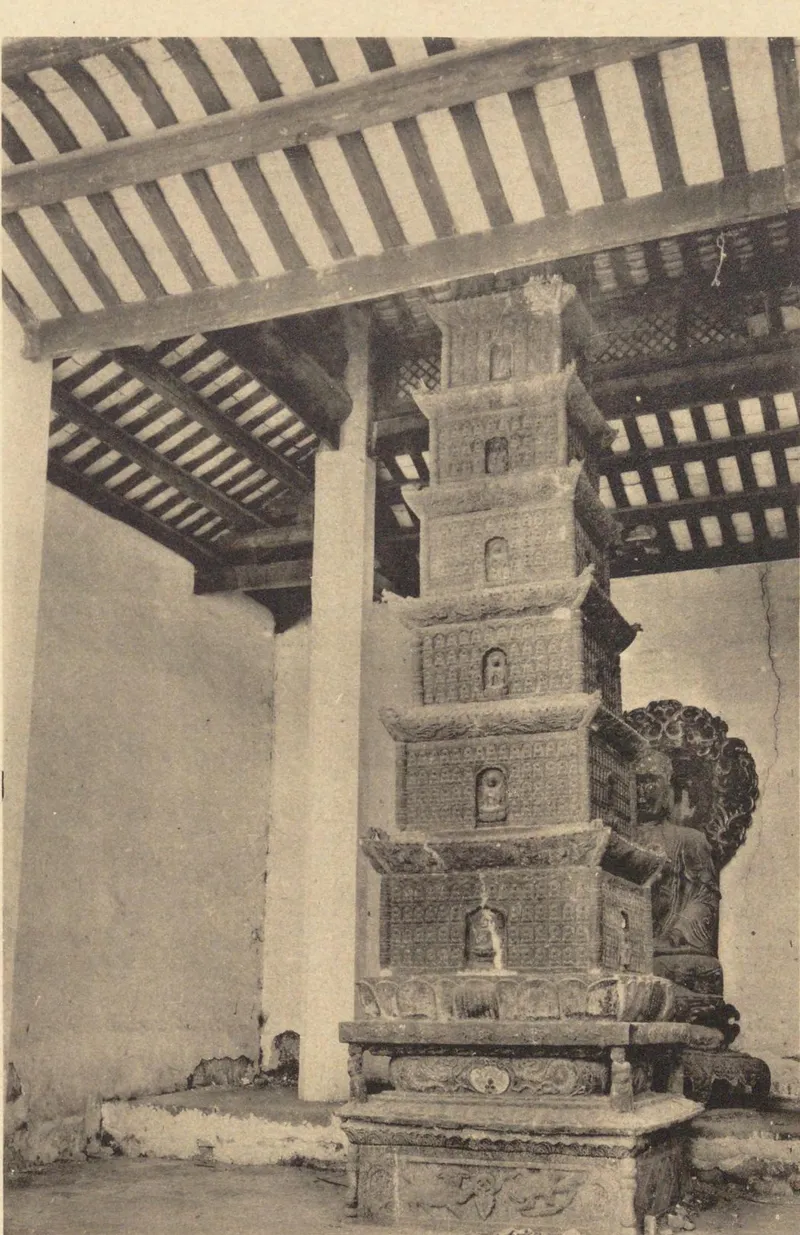
The two iron pagodas standing east and west within the temple were both built under the Southern Han. The one in the western court was cast by the palace attendant-supervisor Gong Chengshu in the sixth year of the Dabao era (the guihai year); the one in the eastern court was cast by imperial order of Liu Chang in the tenth year of the Dabao era (the dingmao year), fully four years later, and its inscription states that it was “cast in black gold” and was “seven stories, together with the finial-disc and lotus base, twenty-two chi high.” Under the Song the temple was once renamed the Qianming Chan Cloister, yet the bell cast in the fourth year of the Xianping era still bears the signature “Faxing Temple, Guangzhou.” On this basis the Nanhai Xianzhi judged the claim of a name change to be “an error of hearsay,” insisting that one must “take the bell’s inscription as authoritative.” By the Qing dynasty, these two iron pagodas became objects to which epigraphers repeatedly returned to identify. Zhu Yizun in his early years saw only rubbings and mistakenly merged the two pagodas into one; not until, on revisiting in the renshen year, Chen Yuanxiao invited him to dine at the temple and the temple monks led him to look, did he discover that they were “two pagodas standing together in one hall, unequal in height, one bearing a record, one bearing inscribed names.” Weng Fanggang, going further by the actual objects, pointed out that the western pagoda was made by Gong Chengshu on his own initiative and earlier, and was besides the work of a eunuch, differing in nature from the imperially ordered eastern pagoda — so that they “cannot be merged into one” in the first place.
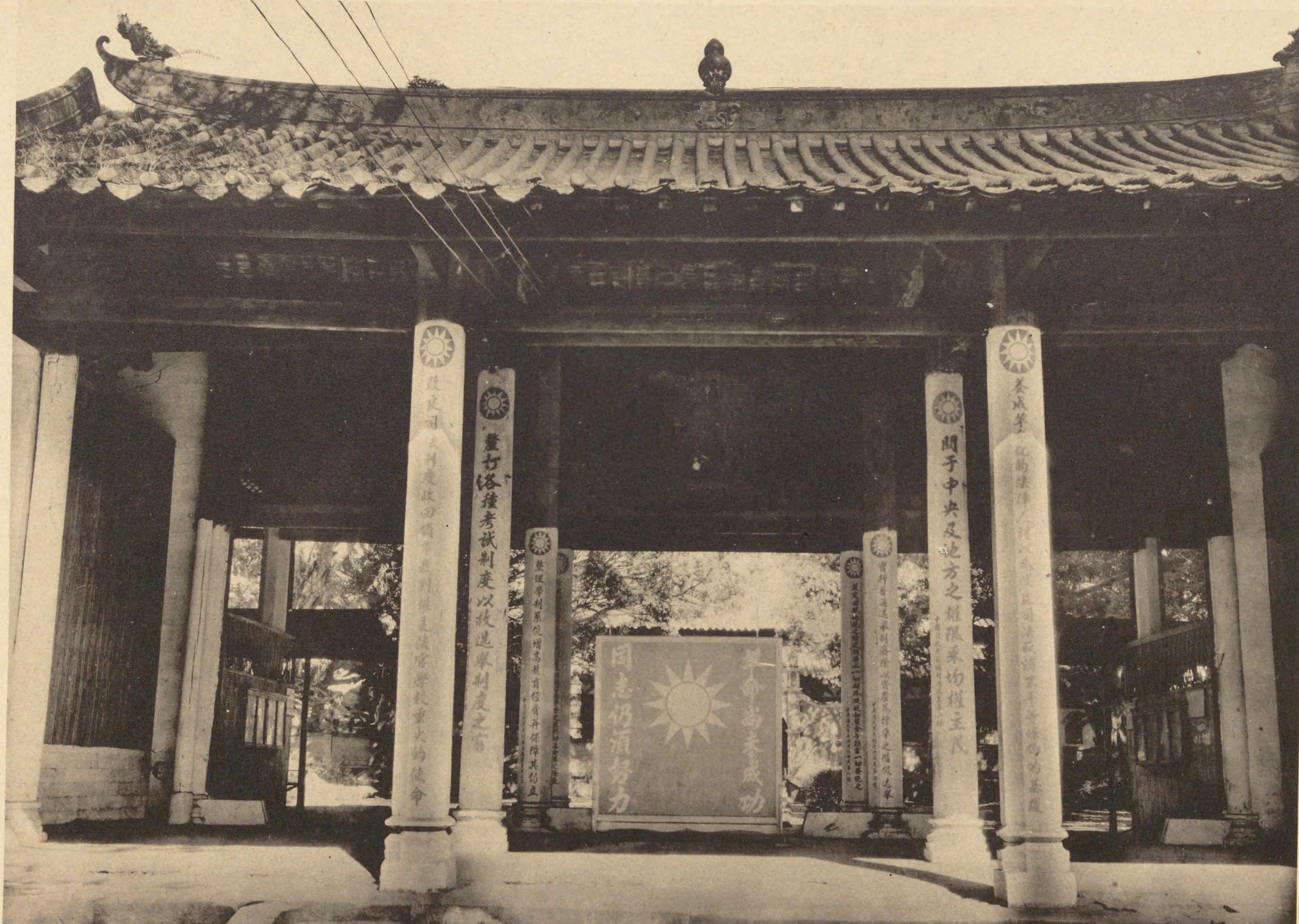
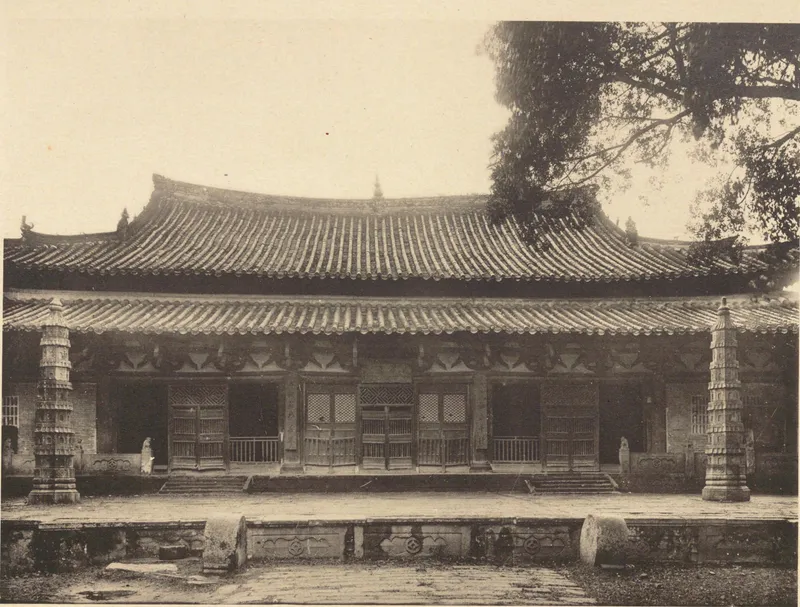
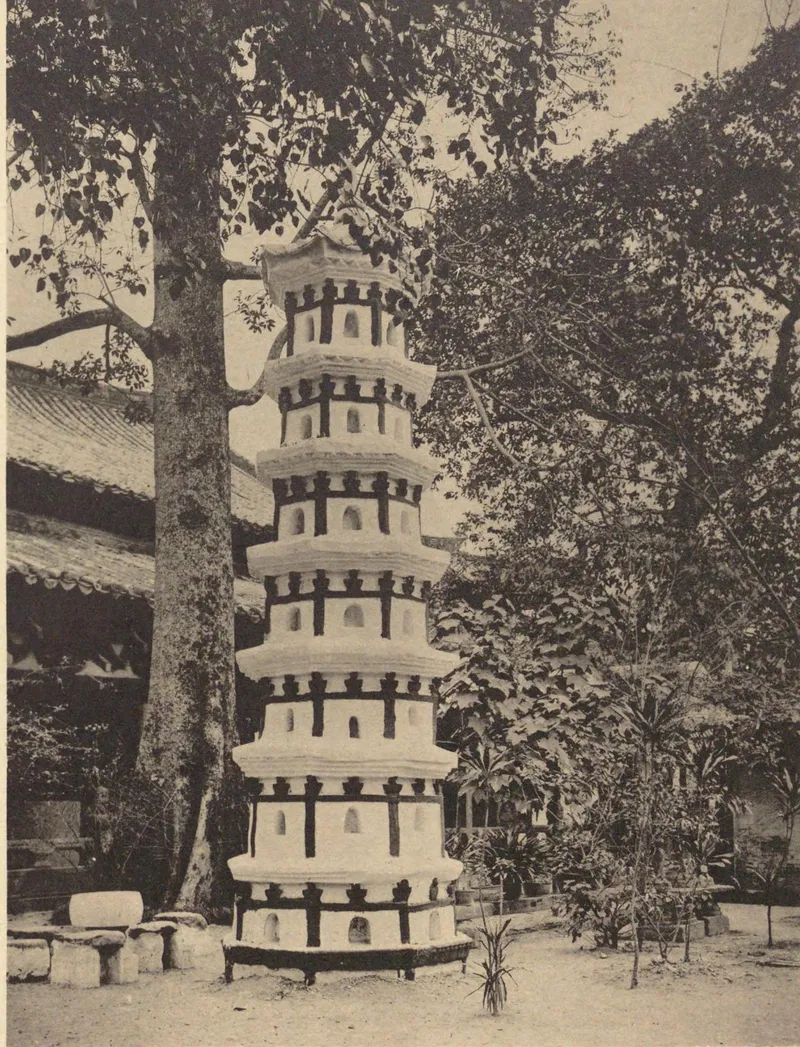
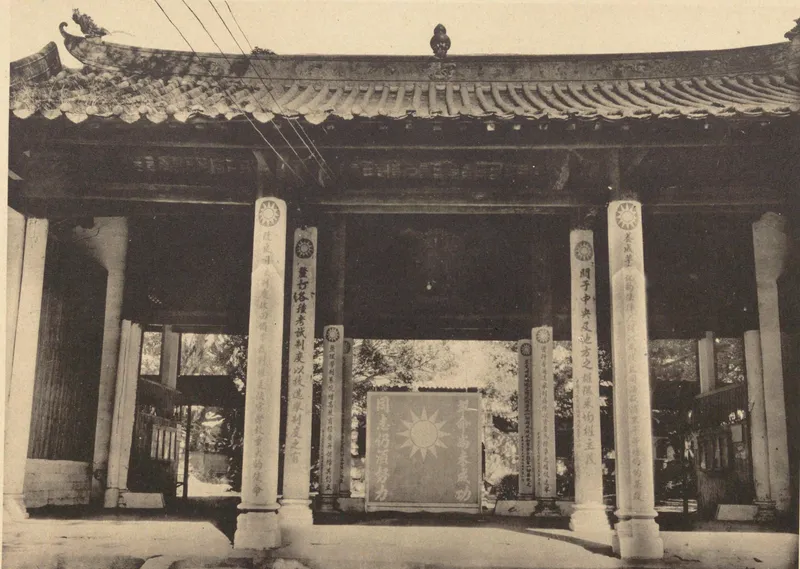
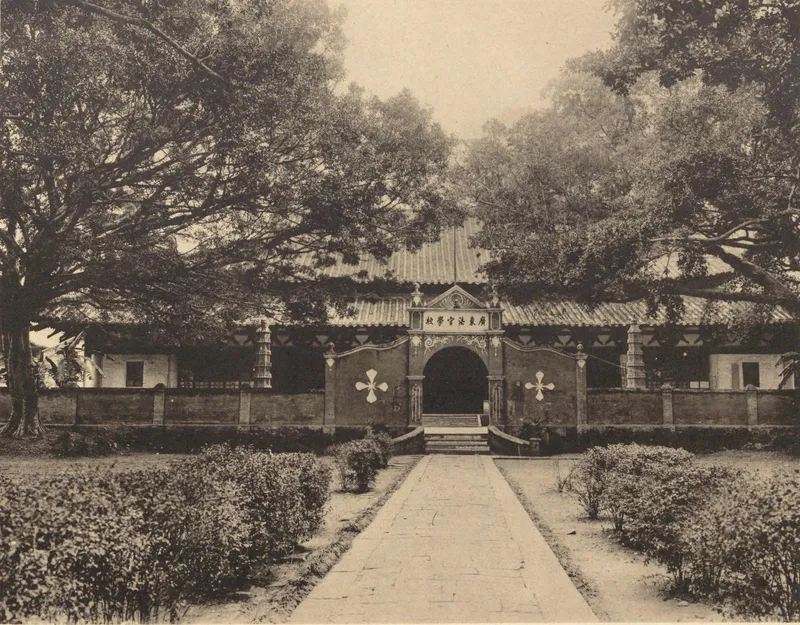
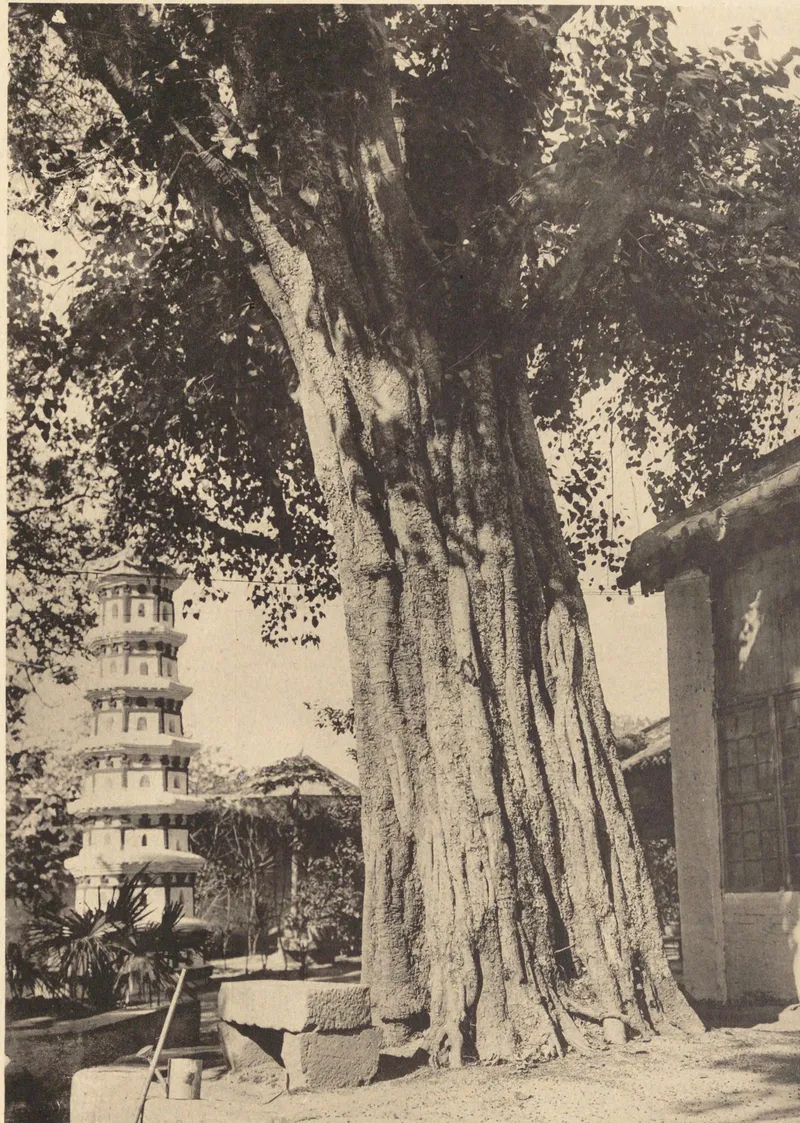
The temple’s uses likewise shifted with the times, again and again. According to the Guangxiaosi Zhi, in the early Qing when Guangzhou passed through upheaval, the temple was once turned into a military barracks and an examination hall. By the Republican era, a school had already moved into the temple compound. In the old photographs collected in Volume III of Tokiwa Daijo and Sekino Tadashi’s Shina Bunka Shiseki, the central gate’s plaque reads “Guangdong Judges’ School”; the same set of photographs also captured the Hall of the Heavenly Kings, the Great Hero Hall, and, before the hall, the Southern Han iron pagoda, the Sixth Patriarch’s Hair-Burial Pagoda, the bodhi tree, and the western iron pagoda.
Historical Documents
《粤游小识》
城西北隅有光孝寺,即孙吴时虞翻故苑,本尉佗元孙建德故宅。仲翔谪南海居此,废其宅为苑圃,多植苹婆、诃子,时人称为虞苑,又曰诃林。
At the northwestern corner of the city stands Guangxiao Temple, which was the former garden of Yu Fan in the time of the Sun Wu, and originally the former residence of Jiande, a distant descendant of Commandant Tuo. Zhongxiang (Yu Fan), banished to Nanhai, dwelt here, turned his residence into a garden plot, and planted many pingpo and myrobalan trees, so that people of the time called it the Yu Garden, and also Helin.
后人以翻未召还,遂谓翻卒于广,则殊失实。夫仲翔居广而再谪苍梧,东坡居惠而再谪海南,骨体不媚,古今同慨,而坡竟北还,则有幸有不幸耳。猛陵迢递,伤如之何?
Later men, because Yu Fan was never recalled, thus said that he died at Guang, which quite misses the fact. Now Zhongxiang dwelt at Guang and was banished again to Cangwu, and Dongpo dwelt at Hui and was banished again to Hainan — men of unbending frame, a lament shared alike in ancient and modern times; yet Dongpo in the end returned north, so there was fortune and there was misfortune. Menglin lies far and remote — how grievous it is!
宅后施为寺,自东晋迄梁武,以及唐、宋间,无不封敕,故历代称大刹。其古迹见存者,有睡佛阁,唐神龙间建。瘗发塔,唐仪凤间建。叉有南汉二铁塔,其在东者,大宝十年丁卯岁造,在西者,大宝六年癸亥岁造。东塔雕刻盘龙,西首惟宝莲花,而高相等。两塔铭均载在阮翁志内,此不录之。
The residence was afterwards donated to become a temple, and from the Eastern Jin down to Emperor Wu of the Liang, as well as through the Tang and Song, it never lacked an imperial patent, and so through the ages it was called a great monastery. Of its ancient relics still surviving, there is the Reclining Buddha Pavilion, built in the Shenlong era of the Tang; the Hair-Burial Pagoda, built in the Yifeng era of the Tang; and further the two iron pagodas of the Southern Han — the one in the east cast in the dingmao year, the tenth year of the Dabao era, and the one in the west cast in the guihai year, the sixth year of the Dabao era. The eastern pagoda is carved with coiling dragons, the western with only jeweled lotus flowers, yet they are equal in height. The inscriptions of both pagodas are recorded in Elder Ruan’s gazetteer, and are not transcribed here.
袁瓌瑀宝璜。游诃林寺
Yuan Gui, styled Baohuang. “Visiting Helin Temple.”
寺为虞仲翔故宅,云:逦迤城西。路,寻幽蜡屐停。五朝铁塔字,一卷石幢经。卧佛津梁倦,菩提劫后青。山僧不解语,避客掩禅扃。
The temple is the former residence of Yu Zhongxiang. It reads: Winding along west of the city; on the road, seeking the secluded, my waxed clogs come to rest. On the five-dynasty iron pagoda, the graven characters; on a single stone pillar, a scroll of scripture. The Reclining Buddha, weary of ferrying men across; the bodhi, green again after the kalpa. The mountain monk cannot speak; avoiding guests, he closes his meditation gate.
子默高州去,虞君亦海滨。故庐今卓锡,怀旧倍怆神。吊客凭千古,传经得解人。西溪遗记读,何处拜明禋。
Zimo departs for Gaozhou; Master Yu too was by the sea’s shore. The old dwelling now holds a planted staff; recalling the past redoubles the sorrow of the spirit. The mourning guest leans on a thousand ages; the transmitted scripture finds one who understands. Reading the surviving record of Xixi — where shall one bow in bright sacrifice?
谓曾宾谷记。
Said to be a record by Zeng Bingu.
《全唐文》
光孝寺
Guangxiao Temple
瘗发塔记
Record of the Hair-Burial Pagoda
佛祖兴世,信非偶然。
That the Buddha-patriarch arose in the world was truly no chance thing.
昔宋朝求那跋佗三藏建兹戒坛,预谶曰:“后当有肉身菩萨受戒于此。”梁天监元年,又有梵僧智药三藏航海而至,自西竺持来菩提树一株,植于戒坛前。
Long ago in the Song dynasty the Tripitaka master Gunabhadra built this precept platform, foretelling in a prophecy: “Hereafter there shall be a flesh-body bodhisattva who receives the precepts here.” In the first year of the Tianjian era of the Liang, there also came the foreign monk, the Tripitaka master Jñānagupta, arriving by sea, who brought from western India a single bodhi tree and planted it before the precept platform.
立碑云:“吾过后一百六十年,当有肉身菩萨来此树下,开演上乘,度无量众,真传佛心印之法王也。”今能禅师正月八日抵此,因论风幡语,而与宗法师说无上道。
He set up a stele that read: “A hundred and sixty years after my passing, there shall come a flesh-body bodhisattva beneath this tree, who will expound the supreme vehicle and deliver countless multitudes — truly the dharma-king who transmits the Buddha’s mind-seal.” Now Chan Master Neng arrived here on the eighth day of the first month, and because of the discourse on the wind and the banner, he spoke of the supreme Way with Dharma Master Zong.
宗踊跃忻庆,昔所未闻。
Zong leapt for joy and rejoiced, for it was what he had never heard before.
遂诘得法端由,于十五日,普会四众,为师祝发。二月八日,集诸名德,受具足戒。
He then inquired into the origins of Neng’s attainment of the Dharma, and on the fifteenth day he assembled the fourfold community to tonsure the master. On the eighth day of the second month, he gathered the eminent worthies, and Neng received the full precepts.
既而于菩提树下,开单传宗旨,一如昔谶。
Thereafter, beneath the bodhi tree, Neng opened the tenet of the single transmission, exactly as the former prophecy had said.
法才遂募众缘,建兹浮屠,瘗禅师发。
Facai then solicited donations from the community and built this stupa to bury the Chan master’s hair.
一旦落成,八面严洁,腾空七层,端如涌出。
Once it was completed, its eight faces solemn and pure, it rose seven stories into the sky, upright as though welling up from the ground.
伟欤禅师!
How great the Chan master was!
法力之厚,弹指即遂,万古嘉猷,巍然不磨。
So deep was the power of the Dharma that in a snap of the fingers it was accomplished; a fine model for ten thousand ages, towering and never to be worn away.
聊叙梗概,以纪岁月云。
I have briefly set down the outline, so as to record the year and month.
仪凤元年岁次丙子吾佛生日,法性寺住持法才谨识。
On the birthday of our Buddha in the first year of the Yifeng era, the bingzi year, Facai, abbot of Faxing Temple, respectfully records this.
《宋高僧传》
就南海印宗法师《涅盘》盛集,论风旙之语,印宗辞屈而神伏,乃为其削椎髻于法性寺,智光律师边受满分戒,所登之坛即南宋朝求那跋摩三藏之所筑也。跋摩已登果位,悬记云:“后当有肉身菩萨于斯受戒。”又梁末真谛三藏于坛之畔手植菩提树,谓众曰:“种此后一百二十年,有开士于其下说无上乘,度无量众。”至是能爰宅于兹,果于树阴开东山法门,皆符前谶也。
At the great assembly on the Nirvana Sutra held by Dharma Master Yinzong of Nanhai, there was the discourse on the wind and the banner; Yinzong, worsted in words and inwardly subdued, then had Huineng’s topknot shaved off at Faxing Temple, and beside the Vinaya Master Zhiguang he received the full precepts. The platform he ascended was the one built by the Tripitaka master Gunavarman in the Liu Song dynasty. Gunavarman, having already attained the fruit of sainthood, left a prophecy that read: “Hereafter there shall be a flesh-body bodhisattva who receives the precepts here.” And at the end of the Liang, the Tripitaka master Paramartha planted with his own hand a bodhi tree beside the platform, saying to the assembly: “A hundred and twenty years after this planting, there will be a great being who beneath it expounds the supreme vehicle and delivers countless multitudes.” When it came to this, Huineng thereupon settled here, and indeed beneath the tree’s shade opened the Dharma-gate of the East Mountain — all matching the former prophecies.
《景德传灯录》
至仪凤元年丙子正月八日,届南海,遇印宗法师于法性寺讲涅盘经。师寓止廊庑闲,暮夜风飏刹幡,闻二僧对论,一云幡动,一云风动。往复酬答,曾未契理。师曰:“可容俗流辄预高论否?直以风幡非动,动自心耳。”印宗窃聆此语,竦然异之。翊日,邀师入室,征风幡之义。师具以理告。印宗不觉起立云:“行者定非常人,师为是谁?”师更无所隐,直叙得法因由。于是印宗执弟子之礼,请受禅要。乃告四众曰:“印宗具足凡夫,今遇肉身菩萨。”即指坐下卢居士云:“即此是也。”因请出所传信衣,悉令瞻礼。至正月十五日,会诸名德,为之剃发。二月八日,就法性寺智光律师受满分戒。其戒坛即宋朝求那跋陀三藏之所置也。三藏记云:“后当有肉身菩萨在此坛受戒。”又梁末真谛三藏于坛之侧,手植二菩提树,谓众曰:“却后一百二十年,有大开士于此树下演无上乘,度无量众。”师具戒已,于此树下开东山法门,宛如宿契。
On the eighth day of the first month in the first year of the Yifeng era, the bingzi year, he came to Nanhai and met Dharma Master Yinzong lecturing on the Nirvana Sutra at Faxing Temple. The master (Huineng) was lodging in the corridors; one evening at night the wind stirred the temple banner, and he heard two monks disputing, one saying the banner was moving, the other saying the wind was moving. Back and forth they answered each other, never once touching the principle. The master said: “May a common fellow be permitted to venture into your lofty discussion? Simply put, it is neither the wind nor the banner that moves; it is your own mind that moves.” Yinzong overheard these words and was struck with awe and wonder at them. The next day he invited the master into his chamber and questioned him on the meaning of the wind and the banner. The master explained it fully by principle. Yinzong, without realizing it, rose to his feet and said: “Practitioner, you are surely no ordinary man. Who are you, master?” The master concealed nothing further and plainly related the origins of his attainment of the Dharma. Thereupon Yinzong observed the etiquette of a disciple and asked to receive the essentials of Chan. He then announced to the fourfold community: “Yinzong is a mere ordinary man; now I have met a flesh-body bodhisattva.” He pointed to the layman Lu seated below and said: “This is he.” He then asked that the robe of faith handed down be brought out, and had all pay reverence to it. On the fifteenth day of the first month, he assembled the eminent worthies and had Huineng’s head shaved. On the eighth day of the second month, before the Vinaya Master Zhiguang of Faxing Temple, Huineng received the full precepts. That precept platform was the one established by the Tripitaka master Gunabhadra of the Song dynasty. The Tripitaka master’s record read: “Hereafter there shall be a flesh-body bodhisattva who receives the precepts on this platform.” And at the end of the Liang, the Tripitaka master Paramartha planted with his own hand two bodhi trees beside the platform, saying to the assembly: “A hundred and twenty years hence, there will be a great being who beneath these trees expounds the supreme vehicle and delivers countless multitudes.” Once the master had received the precepts, beneath these trees he opened the Dharma-gate of the East Mountain, exactly as if by a prior compact.
《南海县志》
光孝寺咸平钟款
The Xianping-era Bell Inscription of Guangxiao Temple
弟子口季迁同慈母李氏、二十一娘口口口口口婆珠等,敬口口钟壹口,重铜卷百觔,奉为亡室周氏口娘迢荐去识生界,以设斋庆𧷙讫,舍沙门义明,永充供养。谨题
The disciple [ ] Jiqian, together with his loving mother Lady Li, Twenty-first Maiden [ ][ ][ ][ ][ ] Pozhu and others, reverently [ ][ ] one bell, weighing a hundred catties of coiled bronze, offered on behalf of his deceased wife Lady Zhou [ ]-niang, to convey and commend her to the realm of the living-and-knowing; having set out a vegetarian feast to celebrate and complete it, they donated it to the monk Yiming to serve forever as an offering. Respectfully inscribed.
临坛比丘义明,舍铜钟一口,重叁百觔,于广州法性寺大佛殿内悬挂,永充常住。二时声击。时大宋咸平四年,岁次辛丑九月一日已已朔七日乙亥,殿主表白传律临坛宗志大师曹亮记
The platform-officiating bhikshu Yiming donated one bronze bell, weighing three hundred catties, to be hung within the Great Buddha Hall of Faxing Temple in Guangzhou, to serve forever as monastery property, struck at the two watches. At the time of the fourth year of the Xianping era of the Great Song, the xinchou year, in the ninth month, the first day being the new moon jisi, on the seventh day yihai — recorded by the hall’s master, the proclaimer and transmitter of the Vinaya, the platform-officiating Great Master Zongzhi, Cao Liang.
按钟在广州光孝寺,款一,行书,一正书,笔意可观。曝书亭集与景云观钟并称,所谓法性寺钟铭者,即此是也。旧志云:法性寺宋太祖改各乾明禅院。据此钟刻于真宗咸平,犹以法性称,则旧志云云,传闻之误耳。当以钟刻为正。
Note: the bell is at Guangxiao Temple in Guangzhou. Of its inscriptions, one is in running script, one in regular script, both worthy of note for their brushwork. In the Pushu Ting Ji it is named alongside the bell of Jingyun Abbey, and what is called the bell inscription of Faxing Temple is precisely this one. The old gazetteer says: Faxing Temple was renamed the Qianming Chan Cloister by Emperor Taizu of the Song. But since this bell was cast in the Xianping era of Emperor Zhenzong and still uses the name Faxing, what the old gazetteer says is merely an error of hearsay. One should take the bell’s inscription as authoritative.
《粤东金石略》
光孝寺铁塔识
The Iron Pagoda Inscriptions of Guangxiao Temple
广州光孝寺有二铁塔,其在东院者,以黄金涂之,南汉主刘录所造。塔下一层识云:大汉皇帝以大宝十奉丁岁,敕有同用乌金铸造千佛宝塔一座,七层,并相莲花座,高二丈二尺,保龙有庆,祈凤历无疆。万方咸于清平,八表永承于交泰。□浚善□三有,福被四息,以四乾德节设斋庆赞。谨记。其南面之左云:内殿大僧录、教中大法师、金紫光禄、捡拔工部尚书晓真大师沙门臣右云教中大法师、内供奉讲经首座金紫夫、捡校工部尚书宝法大师沙门臣其余数面款文皆不可拓。据志北面之左云:毅中大法师、内供奉、金紫光禄大夫、捡校工部尚书绍喜大法师沙门监造。右云:教中大法师、金紫光禄大夫、捡校工部尚书了闻沙门监造。东面之左云:都监住持秀华宫使、上将军、上柱国□伯、食邑十万户□□监造
At Guangxiao Temple in Guangzhou there are two iron pagodas. The one in the eastern court is coated with gold, made by Liu Chang, ruler of the Southern Han. On the lowest story of the pagoda the inscription reads: The Emperor of the Great Han, in the tenth year of the Dabao era, the dingmao year, ordered the proper officials to cast in black gold one Thousand-Buddha treasure pagoda, of seven stories, together with the finial-disc and lotus base, twenty-two chi high — that the dragon-line might be preserved and blessed, and the phoenix-calendar prayed to be without end; that all quarters might rest in peace, and the eight limits forever partake of concord. [ ] deepening goodness [ ] the three realms of existence, and blessings covering the four kindnesses; on the Qiande Festival in the fourth month, a vegetarian feast was set out in celebration. Respectfully recorded. On the left of its south face it reads: the palace grand monk-recorder, grand dharma master of the teaching, gold-and-purple grandee of glory, acting Minister of Works, Great Master Xiaozhen, the monk, your servant [ ]. On the right it reads: grand dharma master of the teaching, inner-attendant chief lecturer of scripture, gold-and-purple grandee, examining Minister of Works, Great Master Baofa, the monk, your servant [ ]. The inscriptions on the remaining faces cannot all be taken in rubbing. According to the gazetteer, on the left of the north face it reads: resolute grand dharma master of the teaching, inner attendant, gold-and-purple grandee of glory, examining Minister of Works, grand dharma master Shaoxi, the monk, superintending the casting. On the right it reads: grand dharma master of the teaching, gold-and-purple grandee of glory, examining Minister of Works, Liaowen, the monk, superintending the casting. On the left of the east face it reads: chief supervisor and abbot, Commissioner of Xiuhua Palace, senior general, senior pillar of state, [ ] earl, with a fief of a hundred thousand households, [ ][ ], superintending the casting.
。寺西院又有千佛铁塔,其识云:玉清宫使、德陵使、龙德宫使、开府仪同三司、行内侍监、上柱国龚澄枢,同女弟子邓氏三十二娘,以大宝六年岁次癸亥五月壬子翔十七戊辰铸造,永充供养
In the temple’s western court there is also a Thousand-Buddha iron pagoda, whose inscription reads: the Commissioner of Yuqing Palace, Commissioner of Deling, Commissioner of Longde Palace, grand master with a household establishment equal in ceremony to the Three Dukes, acting palace attendant-supervisor, senior pillar of state, Gong Chengshu, together with the female disciple Lady Deng, Thirty-second Maiden, cast it in the sixth year of the Dabao era, the guihai year, in the fifth month whose new moon was renzi, on the seventeenth day wuchen, to serve forever as an offering.
。两塔高大略相等,东塔较高。朱竹垞谓见二塔并立一屋中,修短不齐,一作祀,一题名,始悟曩时拓本合二为一,记之不详,疑未得其实也。又谓其列名皆官者,今观其列名皆沙门监造,而宦者惟龚澄枢一人。且其塔乃澄枢自造,又在𬬮所造之前,亦不得合为一也。
The two pagodas are roughly equal in height and size, the eastern being somewhat taller. Zhu Zhucha (Zhu Yizun) said that when he saw the two pagodas standing together in one hall, unequal in height, one bearing a record and one bearing inscribed names, he first realized that in his earlier rubbings he had merged the two into one, that his account had been imprecise, and he suspected he had not grasped the truth of it. He also said that the names listed were all of officials; but now, observing that the listed names are all of monks superintending the casting, with Gong Chengshu the only eunuch among them — and moreover that his pagoda was made by Chengshu on his own initiative, and earlier than the one made by Liu Chang — they likewise cannot be merged into one.
又按竹垞书铁塔铭后,记刘䶮冢碑事,与王文𫈉皇华纪闻所载,颇有错互。余甲申秋将出都时,钱享楣学士。首以此托为考订。比抵粤,访诸官吏与土人,问其所谓北亭者,在番禺城东二十里许,而刘䶮之冢与碑,则竟无知者。盖二先生亦皆非得自亲睹,所以传写或有讹失。即如竹垞所记,系光天元年,而文𫈉则疑光天无五年,而所据载者乃作五年。又卢应下文简所记是初字,广东新语所记是敕字,俱无奉字,而竹垞所记则多一奉字,安知初字非即敕字之误乎?竹垞称陈元孝语予云,则是竹垞既得自口传,而元孝复幽记忆,无怪乎王、朱两先生之传闻异词矣
Further, I note that in Zhucha’s colophon after the iron-pagoda inscription, his account of the matter of Liu Yan’s tomb-stele differs considerably from what Wang Wenjian records in his Huanghua Jiwen. In the autumn of the jiashen year, as I was about to leave the capital, the academician Qian Xiangmei first entrusted me with collating this. When I reached Guangdong, I inquired of officials and local people, asking about what they called Beiting, which lies some twenty li east of the city of Panyu; but of Liu Yan’s tomb and stele, none in the end had any knowledge. It seems the two gentlemen likewise did not obtain their accounts from personal observation, and so in transmission and transcription there may be errors. For instance, what Zhucha records is the first year of the Guangtian era, whereas Wenjian doubts that Guangtian had a fifth year, yet the source he relied on gives “fifth year.” Again, what Lu Ying’s subsequent text records is the character chu (first), what the Guangdong Xinyu records is the character chi (imperial order), and neither has the character feng (by command); yet what Zhucha records has one extra feng. How is one to know that the character chu is not simply a corruption of the character chi? Zhucha states that Chen Yuanxiao told him this, so that Zhucha obtained it by word of mouth, and Yuanxiao in turn recalled it dimly — no wonder that the two gentlemen Wang and Zhu differ in their hearsay accounts.
《金石文字跋尾》
广州光孝寺铁塔记跋呜呼,僭窃之主,未有愚于刘𬬮者也。
Colophon to the Iron Pagoda Record of Guangxiao Temple, Guangzhou. Alas, among rulers who usurped and stole their thrones, none was more foolish than Liu Chang.
谓群臣有家室,顾子孙惟宦者可信,不知其植党纳贿更甚焉。铁塔建自大宝十年,凡七层,合相轮莲花座,崇二丈有二尺。观其列名,皆宦者也。当其时,𬬮又范铜为己像,并肖诸子,列于天庆观,而今已亡之。盖金石刻之传于世,金之用博,故其铄也易。以予所见,自唐以来,惟景云观法性寺二钟铭及是塔记而已。若晋祠铁人,铸自宋建中靖国年,则其文在胸突出,难以摹搨,盖款识不同,变前人之旧矣。
He held that his officials had households of their own, and reckoned that of his descendants only the eunuchs could be trusted, not knowing that they planted factions and took bribes all the more grievously. The iron pagoda was built in the tenth year of the Dabao era, seven stories in all, together with the finial-disc and lotus base, twenty-two chi tall. Observing the names it lists, they are all of eunuchs. At that time, Chang also cast bronze into an image of himself, and likenesses of his sons as well, and set them up in Tianqing Abbey — but these are now lost. For of the epigraphy transmitted to the world, metal is broadly used, and so it is readily melted down. Of all that I have seen, from the Tang onward there are only the two bell inscriptions of Jingyun Abbey and Faxing Temple, and this pagoda record. As for the iron figures of the Jin Shrine, cast in the Jianzhong Jingguo year of the Song, their inscriptions stand out in relief on the chest and are hard to take in rubbing, for the manner of inscribing differs, having altered the old ways of former men.
续书光孝寺铁塔铭后:岁在壬申,重游岭表。改岁正月,南海陈元孝饭予光孝寺,南汉之兴王寺也。寺僧导主客诣刘𬬮所铸铁塔所在,见二塔并立一屋中,修短不齐,一作记,一题名,始悟曩时拓本合二为一,记之不详。元孝语予,南汉主刘龚,葬番禺县治东二十里北亭。明崇祯丙子秋九月,穴中有鸡鸣。土人发其墓,隧道崇五尺,深三尺,有金像十二,一冕而坐,一笄而坐,殆马后也。夹侍十人,疑是诸子。又学士十八,以白金镕铸,其他珍异物甚伙。有碑一具,书翰林学士、知制诰、正议大夫、尚书右丞、上紫金袋臣卢应奉敕撰。文曰:维大有十五年,岁次壬寅,四月甲寅朔廿四日丁丑,高祖天皇大帝崩于正寝,越光天元年正月癸未朔十四日丙申,迁神于康陵,礼也。云云。
A further colophon written after the iron pagoda inscription of Guangxiao Temple: In the renshen year, I revisited the region beyond the Ranges. At the turn of the year, in the first month, Chen Yuanxiao of Nanhai gave me a meal at Guangxiao Temple, which was the Xingwang Temple of the Southern Han. The temple monks led host and guest to the place of the iron pagodas cast by Liu Chang, and I saw two pagodas standing together in one hall, unequal in height, one bearing a record and one bearing inscribed names, whereupon I first realized that my earlier rubbings had merged the two into one, and that my account had been imprecise. Yuanxiao told me that Liu Gong, ruler of the Southern Han, was buried at Beiting, twenty li east of the seat of Panyu County. In the autumn, the ninth month of the bingzi year of the Chongzhen era of the Ming, there was the crowing of a cock within the pit. Local people opened his tomb; the tunnel was five chi high and three chi deep, and there were twelve golden images, one seated wearing a crown, one seated wearing a hairpin — presumably the empress. Ten attendants flanked them, thought to be his sons. There were also eighteen academicians, cast in white metal, and a great many other precious and rare objects besides. There was one stele, inscribed by the Hanlin academician, drafter of edicts, grandee of upright counsel, right assistant of the Department of State Affairs, bearer of the purple-and-gold pouch, your servant Lu Ying, composed by imperial command. Its text read: In the fifteenth year of the Dayou era, the renyin year, in the fourth month whose new moon was jiayin, on the twenty-fourth day dingchou, the Exalted Ancestor, the Heavenly August Great Emperor, expired in his proper chamber; and in the first year of the Guangtian era, in the first month whose new moon was guiwei, on the fourteenth day bingshen, his spirit was removed to Kangling, as was proper. And so on.
子方注五代史,衰年健忘,遂牵连书于前册。亡友仁和吴志伊撰十国春秋,卢应更作膺,谓事龚为工部侍郎,大有中加太尉,中宗时拜中书侍郎、同平章事,衔名不合,惜其已逝,未得此异闻也。
I was then annotating the History of the Five Dynasties, and being forgetful in my declining years, I strung this in along with an earlier fascicle. My late friend Wu Zhiyi of Renhe, who compiled the Chunqiu of the Ten Kingdoms, wrote Lu Ying’s name with the other character Ying, saying that he served Gong as Vice Minister of Works, was made Grand Commandant in the Dayou era, and in the time of Zhongzong was appointed Vice Director of the Secretariat and joint manager of affairs — his titles do not agree. It is a pity that he has already passed away and did not get to hear this unusual account.
《广州府志》
西铁塔铭:
Inscription of the Western Iron Pagoda:
卢迦郍佛释迦佛,玉清宫使、德口口口囗宫使、开府仪同三口囗内侍监口口国龚囗口同女弟子囗口口口口,以大謽六年口口口亥五月壬子朔,口口
Lokana Buddha, Shakyamuni Buddha. The Commissioner of Yuqing Palace, Commissioner of De[ ][ ][ ] Palace, grand master with a household establishment equal in ceremony to the Three [ ], [ ] palace attendant-supervisor, [ ] of state, Gong [ ][ ], together with the female disciple [ ][ ][ ][ ], in the sixth year of the Dabao era, [ ][ ]-hai, in the fifth month whose new moon was renzi, [ ][ ]
口铸造口囗囗入缘,弟子内给事都监韶州梁口鄂
[ ] cast [ ][ ][ ] to enter the karmic bond; the disciple, palace attendant and chief supervisor of Shaozhou, Liang [ ]’e.
卢舍郍佛弥口佛,玉清宫使、德陵使、口口
Locana Buddha, Mai[ ] Buddha. The Commissioner of Yuqing Palace, Commissioner of Deling, [ ][ ]
宫使、口府仪同、三口口内侍口口口国、口口口同,女弟子口口三十二口,以大宝口口岁次癸口五月壬子朔,口囗口口辰,铸造口囗口口入缘,弟子内给事都监。韶州梁延鄂曰毗口口佛药师佛,玉清宫使、德陵使、龙口宫使、开府仪同三司,口内侍监、上柱国龚口囗同女弟子。囗氏三十一口,以大宝六年岁次口亥,五月壬子朔,十七曰口辰,铸造永口口口入缘弟子内给事都监囗州梁延鄂口口佛弥勒佛、玉清宫使、德陵使、龙德宫使、开府仪同三司、行丙侍监、上柱国龚澄枢同女弟子邓氏三十二娘,以大宝六年岁次癸亥,五月壬子朔,十七曰戊辰铸造,永充供养入缘弟子内口口口口口口延鄂
Palace Commissioner, grand master with a household establishment equal in ceremony to the Three [ ], [ ][ ] palace attendant [ ][ ][ ] of state, [ ][ ][ ] together with, the female disciple [ ][ ] Thirty-second [ ], in the [ ][ ] year of the Dabao era, the gui[ ] year, in the fifth month whose new moon was renzi, on [ ][ ][ ]-chen, cast it [ ][ ][ ][ ] to enter the karmic bond; the disciple, palace attendant and chief supervisor, Liang Yan’e of Shaozhou. Also Vipa[ ][ ] Buddha, Bhaisajyaguru Buddha. The Commissioner of Yuqing Palace, Commissioner of Deling, Commissioner of Long[ ] Palace, grand master with a household establishment equal in ceremony to the Three Dukes, [ ] palace attendant-supervisor, senior pillar of state, Gong [ ][ ], together with the female disciple Lady [ ], Thirty-first [ ], in the sixth year of the Dabao era, the [ ]-hai year, in the fifth month whose new moon was renzi, on the seventeenth day [ ]-chen, cast it forever [ ][ ][ ] to enter the karmic bond; the disciple, palace attendant and chief supervisor, Liang Yan’e of [ ]zhou. [ ][ ] Buddha, Maitreya Buddha. The Commissioner of Yuqing Palace, Commissioner of Deling, Commissioner of Longde Palace, grand master with a household establishment equal in ceremony to the Three Dukes, acting palace attendant-supervisor, senior pillar of state, Gong Chengshu, together with the female disciple Lady Deng, Thirty-second Maiden, in the sixth year of the Dabao era, the guihai year, in the fifth month whose new moon was renzi, on the seventeenth day wuchen, cast it to serve forever as an offering; the disciple, palace [ ][ ][ ][ ][ ][ ] Yan’e.
口弟子刘军口。
[ ] the disciple Liu Jun [ ].
岁在壬申,重游岭表。改岁正月,南海陈元孝饭千光孝寺,南海之兴王寺也。寺僧导主客,谓刘𬬮所铸铁塔所在。见一塔并立一屋中,修短不齐,一作记,一题名,始悟曩时拓本合二为一,记之不详。元孝语予南汉主刘袭葬番禺县治东二十里北亭,明崇祯丙子秋九月,穴中有鸡鸣。土人发其墓,隧道崇五尺,深三尺,有金像十一,一冕而坐,一笄而坐,殆马后也。夹侍十人,疑是诸子。又学士十八,以白金镕铸,其他珍异物甚伙。有碑一具,书翰林学士、知制诰、正议大夫、尚书右丞、上紫金袋臣卢应奉敕撰。文曰:维大有十五年,岁次壬寅,四月甲寅朔,念四曰丁丑,高祖天皇大帝崩于正寝,越光天元年五月癸未朔十四日丙申,迁神于康陵,礼也。云云。子方注五代史,衰年健忘,遂牵连书于前册。亡友仁和吴志伊撰十国春秋,卢应更作膺,谓事䶮为工部侍郎,大有中加太尉,中宗时拜中书侍郎、同平章事,衔名不合,惜其已逝,未得此异闻也。
In the renshen year, I revisited the region beyond the Ranges. At the turn of the year, in the first month, Chen Yuanxiao of Nanhai gave me a meal at Guangxiao Temple, which was the Xingwang Temple of Nanhai. The temple monks led host and guest, saying it was the place of the iron pagodas cast by Liu Chang. I saw the pagodas standing together in one hall, unequal in height, one bearing a record and one bearing inscribed names, whereupon I first realized that my earlier rubbings had merged the two into one, and that my account had been imprecise. Yuanxiao told me that Liu Yan, ruler of the Southern Han, was buried at Beiting, twenty li east of the seat of Panyu County. In the autumn, the ninth month of the bingzi year of the Chongzhen era of the Ming, there was the crowing of a cock within the pit. Local people opened his tomb; the tunnel was five chi high and three chi deep, and there were eleven golden images, one seated wearing a crown, one seated wearing a hairpin — presumably the empress. Ten attendants flanked them, thought to be his sons. There were also eighteen academicians, cast in white metal, and a great many other precious and rare objects besides. There was one stele, inscribed by the Hanlin academician, drafter of edicts, grandee of upright counsel, right assistant of the Department of State Affairs, bearer of the purple-and-gold pouch, your servant Lu Ying, composed by imperial command. Its text read: In the fifteenth year of the Dayou era, the renyin year, in the fourth month whose new moon was jiayin, on the twenty-fourth day dingchou, the Exalted Ancestor, the Heavenly August Great Emperor, expired in his proper chamber; and in the first year of the Guangtian era, in the fifth month whose new moon was guiwei, on the fourteenth day bingshen, his spirit was removed to Kangling, as was proper. And so on. I was then annotating the History of the Five Dynasties, and being forgetful in my declining years, I strung this in along with an earlier fascicle. My late friend Wu Zhiyi of Renhe, who compiled the Chunqiu of the Ten Kingdoms, wrote Lu Ying’s name with the other character Ying, saying that he served Yan as Vice Minister of Works, was made Grand Commandant in the Dayou era, and in the time of Zhongzong was appointed Vice Director of the Secretariat and joint manager of affairs — his titles do not agree. It is a pity that he has already passed away and did not get to hear this unusual account.
右龚澄枢造铁塔在广州光孝寺,文凡七行,世所传者,惟西一面文。乾隆甲午夏,益都李文藻素伯谛观。东南北三面铁绣,中隐现有字,募人锥出搨之,文皆与西面同,而每行字数有多寡,盖非一箔也。素伯又为文记塔之形制云:塔自趺以上,高丈有九尺六寸。石趺四重,刻狮兽,铁趺四重,一作瓦檐形,二作龙戏,五珠缩其地廉外为四人首戴,第三重,如赑㞒状。三重亦刻花纹。四重周作莲花,四面各阔四尺六寸,为瓣九,中瓣刻文于上。自莲花瓣以上,凡七层,以次而狭,皆铸佛像。最上阔不过二尺,又为莲花顶,每层大佛一,众小佛环之。每面七层,计二百五十佛,四之则千佛矣。下二层,佛旁有字,梯而视之,弟一层,东曰释迦佛,西曰弥勒佛,南曰弥陀佛,北曰药师佛。药师佛者,释家谓之功德佛,其造塔者自况乎。第二层,东卢遮那佛,南卢舍那佛,西牟尼佛,北毗舍浮佛。它佛名皆刻佛左,而此独刻佛右。塔顶似有字,势甚危,不可梯也。
The iron pagoda made by Gong Chengshu at the above is at Guangxiao Temple in Guangzhou; its text runs to seven columns, and what has been transmitted in the world is only the text of the western face. In the summer of the jiawu year of the Qianlong era, Li Wenzao, styled Subo, of Yidu examined it closely. On the eastern, southern, and northern faces, iron rust had left characters faintly showing through, and he hired men to chisel them out and take rubbings; the texts all agreed with the western face, but the number of characters per column varied, for they were not from a single mold. Subo also wrote an account of the pagoda’s form: from the base upward, the pagoda is nineteen chi and six cun tall. The stone base has four tiers, carved with lion-beasts; the iron base has four tiers, the first in the form of a tiled eave, the second with dragons at play, the five beads drawing in at their lower edge, and on the outside four human heads bearing it up; the third tier is like a bixi tortoise-form. The three tiers are also carved with floral patterns. The fourth tier is worked all around with lotus flowers, each of the four faces four chi and six cun wide, with nine petals, the central petal having text carved upon it. From the lotus petals upward there are seven stories, each narrower in turn, all cast with Buddha images. The topmost is no more than two chi wide, and is capped with a lotus crown; each story has one large Buddha, ringed by many small Buddhas. With seven stories on each face, that comes to two hundred and fifty Buddhas; multiplied by four, that makes a thousand Buddhas. On the lower two stories there are characters beside the Buddhas, seen by climbing a ladder: on the first story, the east reads Shakyamuni Buddha, the west Maitreya Buddha, the south Amitabha Buddha, the north Bhaisajyaguru Buddha. Bhaisajyaguru Buddha is what the Buddhists call the Buddha of Merit — did the pagoda’s maker liken himself to it? On the second story, the east is Vairochana Buddha, the south Locana Buddha, the west Muni Buddha, the north Vishvabhu Buddha. The names of the other Buddhas are all carved to the Buddha’s left, and this one alone is carved to the Buddha’s right. The pagoda top seems to have characters, but its position is very precarious and cannot be reached by ladder.
塔在广州光孝寺之西院。唐六典:内侍省:内侍四人,从四品上。新唐书百官志:内侍省:监二人,从三品。内侍四人,从四品。注云:龙朔二年,改监为省。天賮十三年,置内侍监,则唐自天宝后称内侍监。五代会要:后唐同光元年,以左监门卫将军判内侍省李绍宏兼内局,则后唐已复修省。要之,南汉承唐、梁之制,内侍省有监内侍,而未尝称其官为内侍监,当以此塔题衔为据。宋史通鉴及十国春秋称澄枢为内侍省,似并误。又旧唐书职官志:武德令:职事解散欠一阶不至为兼职事卑者不解散官。贞观令:以职事高者为守,职事卑者为行,仍各带散。位,其欠一阶,依旧为兼,与当阶者皆解散官。则澄枢初以知承宣院兼内侍监遁州厂,见卷力
The pagoda is in the western court of Guangxiao Temple in Guangzhou. The Tang Liudian states: in the Palace Attendants’ Bureau there are four palace attendants, of the upper fourth rank. The Treatise on Officials in the Xin Tang Shu states: in the Palace Attendants’ Bureau there are two supervisors, of the third rank; four palace attendants, of the fourth rank; a note says that in the second year of the Longshuo era the supervisorship was renamed a bureau, and in the thirteenth year of the Tianbao era the office of palace attendant-supervisor was established — so that from the Tianbao era onward the Tang used the title palace attendant-supervisor. The Wudai Huiyao states: in the first year of the Tongguang era of the Later Tang, the general of the Left Palace Gate Guard, Li Shaohong, judging the Palace Attendants’ Bureau, concurrently held the inner bureau — so that the Later Tang had already restored and repaired the bureau. In sum, the Southern Han followed the institutions of the Tang and Liang: the Palace Attendants’ Bureau had a supervisor of palace attendants, but never called that office “palace attendant-supervisor,” and one should take this pagoda’s inscribed title as authoritative. That the Song Shi, the Tongjian, and the Chunqiu of the Ten Kingdoms call Chengshu a member of the Palace Attendants’ Bureau appears in both cases to be an error. Again, the Treatise on Offices in the Jiu Tang Shu: the Wude ordinances held that an official post lacking one rank-step from parity was to be treated as a concurrent post, and a lowly post did not dissolve the prestige rank. The Zhenguan ordinances: one whose substantive office was higher was styled “acting-guardian,” one whose office was lower was styled “acting”; each still carried a prestige rank. For a post lacking one step, it remained as before a concurrent post, and for one at the proper step the prestige rank was dissolved. Thus Chengshu at first, as director of the Chengxuan Court, concurrently held the office of palace attendant-supervisor of Dunzhou [ ] — see the fascicle.
。后又以开封府仪同三司行内侍监,传乃误监为省,又漏其后一官,并略其勋上柱国耳。塔款又载入缘弟子梁延鄂,史传无考。其题衔称内给事都监。按六典百官志,内给事从五品,无都监之名。十国春秋百官表亦不载,当据此以补其缺。塔顶为莲花形,无字。李文藻之言,臆说也。
Afterward he further became, with the household establishment equal in ceremony to the Three Dukes of Kaifeng, acting palace attendant-supervisor; the transmitted accounts then mistook “supervisor” for “bureau,” and further omitted this latter office, and also left out his merit-title of senior pillar of state. The pagoda inscription further records the karmically bonded disciple Liang Yan’e, of whom the histories and biographies give no account. His inscribed title reads “palace attendant and chief supervisor.” According to the treatises on officials in the Liudian, the palace attendant is of the fifth rank, and there is no title of “chief supervisor.” The table of officials in the Chunqiu of the Ten Kingdoms likewise does not record it, and one should use this to supply the gap. The pagoda top is in the form of a lotus and has no characters. Li Wenzao’s statement is mere conjecture.
东铁塔记:大汉皇帝以大宝十年丁口岁,敕有司用乌金铸造千佛宝塔壹所,七层,并相口莲花座,高二丈二尺。保龙口有庆,祈凤历无疆。万方咸使于清平,八表永承于交泰,然后善资三有,福被四恩。以四月乾德节设斋庆赞。谨记。囗口口口口囗口口口军容口口口口口阳宫使秀囗口口囗华宫使口囗口囗口囗使言瘴囗口口番点检口口口上将军行丙口口囗囗一开国伯,食邑七百户口口口口口教中大法师内囗口监口口口口口口口大夫、检校工部尚书囗法师沙口臣口口教中大法口口口囗口囗囗囗口口口口大夫、检校口部尚书口口口囗沙门臣口口教中大法师内供奉讲经首座金紫口口口夫、检校工部尚书宝法大师沙门臣口口内殿大僧录教中大法师金紫光禄口口、检校工部尚书晓真大师沙门臣道
Record of the Eastern Iron Pagoda: The Emperor of the Great Han, in the tenth year of the Dabao era, the ding[ ] year, ordered the proper officials to cast in black gold one Thousand-Buddha treasure pagoda, of seven stories, together with the [ ]-disc and lotus base, twenty-two chi high. That the dragon [ ] be preserved and blessed, and the phoenix-calendar prayed to be without end; that all quarters be made to rest in peace, and the eight limits forever partake of concord; and thereafter that goodness aid the three realms of existence, and blessings cover the four kindnesses. On the Qiande Festival in the fourth month, a vegetarian feast was set out in celebration. Respectfully recorded. [ ][ ][ ][ ][ ][ ][ ][ ][ ] military supervisor [ ][ ][ ][ ][ ] Commissioner of [ ]yang Palace, Commissioner of Xiu[ ][ ][ ]hua Palace, [ ][ ][ ][ ][ ][ ] Commissioner, [ ] miasma [ ][ ][ ] inspector of the [ ][ ][ ] senior general, acting [ ][ ][ ][ ][ ] earl of a founded state, with a fief of seven hundred households, [ ][ ][ ][ ][ ] grand dharma master of the teaching, inner [ ][ ] supervisor [ ][ ][ ][ ][ ][ ][ ] grandee, examining Minister of Works, [ ] dharma master, the monk your servant [ ][ ]; grand dharma master of the teaching [ ][ ][ ][ ][ ][ ][ ][ ][ ][ ][ ][ ] grandee, examining Minister of [ ], [ ][ ][ ][ ] the monk your servant [ ][ ]; grand dharma master of the teaching, inner-attendant chief lecturer of scripture, gold-and-purple [ ][ ][ ] grandee, examining Minister of Works, Great Master Baofa, the monk your servant [ ][ ]; the palace grand monk-recorder, grand dharma master of the teaching, gold-and-purple grandee of glory [ ][ ], examining Minister of Works, Great Master Xiaozhen, the monk your servant Dao[ ].
右造千佛宝塔记,在光孝寺之东院,寺僧以灰填其文,而涂金于外,谓之金塔记。在塔之西面,凡八行。其北面东隅题名二行,西隅题名三行,东面南隅题名二行,西隅题名。三行,东面南隅题名二行。西面两隅及东西之北隅,皆无刻交。予所藏者李素伯手榻之本,视他家特为完善。寺之西有龚澄枢所造铁塔,先于此塔四年,亦非奉敕所造。朱锡鬯谓刘𬬮所铸二塔并立一屋中,一作记,一题名者,误也。此塔题名六人,惟所谓宫使者,似是内侍之职,余皆沙门尔。朱以为皆宦者,亦误。
The Record of the Casting of the Thousand-Buddha Treasure Pagoda at the above is in the eastern court of Guangxiao Temple; the temple monks filled its text with plaster and coated the outside with gold, calling it the Golden Pagoda Record. It is on the western face of the pagoda, running to eight columns. On the north face, the eastern corner has two columns of inscribed names, the western corner three columns; on the east face, the southern corner has two columns, the western corner three columns; on the east face, the southern corner has two columns. The two corners of the west face, and the northern corners of east and west, all have no carving. What I possess is Li Subo’s own hand-taken rubbing, which is especially complete compared with those of other collectors. To the west of the temple there is the iron pagoda made by Gong Chengshu, four years earlier than this pagoda, and likewise not made by imperial command. Zhu Xichang’s claim that the two pagodas cast by Liu Chang stand together in one hall, one bearing a record and one bearing inscribed names, is an error. This pagoda’s inscribed names number six persons; only the so-called palace commissioner seems to hold an office of palace attendant, and the rest are all monks. Zhu’s supposition that they are all eunuchs is likewise an error.
铁塔建自大宝十年,凡七层,合相轮莲花座,崇二丈有二尺。观其列名,皆宦者也。当其时,银又范铜为已像,并肖诸子列于天庆观,而今已亡之。盖金石刻之传于世,金之用博,故其铄也易。以予所见,自唐以来,惟景云观、法性寺二钟铭及是塔记而已。
The iron pagoda was built in the tenth year of the Dabao era, seven stories in all, together with the finial-disc and lotus base, twenty-two chi tall. Observing the names it lists, they are all of eunuchs. At that time, Chang also cast bronze into an image of himself, and likenesses of his sons as well, and set them up in Tianqing Abbey — but these are now lost. For of the epigraphy transmitted to the world, metal is broadly used, and so it is readily melted down. Of all that I have seen, from the Tang onward there are only the two bell inscriptions of Jingyun Abbey and Faxing Temple, and this pagoda record.
广州光孝寺有二铁塔,其在东院者,以黄金涂之,南汉主刘𬬮所造。寺西院又有千佛铁塔,两塔高大略相等,东塔较高。朱竹埋谓见二塔并立一屋中,修短不齐,一作记,一题名,始悟曩时拓本合二为一,记之不详,疑未得其实也。又谓其列名皆宦者,今观其列名,皆沙门监造,而宦者惟龚澄枢一人,且其塔乃澄枢自造,又在𬬮所造之前,亦不得合为一也。
At Guangxiao Temple in Guangzhou there are two iron pagodas. The one in the eastern court is coated with gold, made by Liu Chang, ruler of the Southern Han. In the temple’s western court there is also a Thousand-Buddha iron pagoda; the two pagodas are roughly equal in height and size, the eastern being somewhat taller. Zhu Zhucha said that when he saw the two pagodas standing together in one hall, unequal in height, one bearing a record and one bearing inscribed names, he first realized that his earlier rubbings had merged the two into one, that his account had been imprecise, and he suspected he had not grasped the truth of it. He also said that the names listed were all of eunuchs; but now, observing that the listed names are all of monks superintending the casting, with Gong Chengshu the only eunuch among them — and moreover that his pagoda was made by Chengshu on his own initiative, and earlier than the one made by Liu Chang — they likewise cannot be merged into one.
塔在广州光孝寺之东院,盖后主敕有司所造也。纪年丁下阙一字、卯字也。记后题名磨灭过半。然审视南面东隅所书官阶,其成文可读,有所谓秀华宫使者、将军者、食邑七百户者,其残阙之字,有所谓阳宫使者、使宫闱者、番检点者。考宋史及十国春秋李托传:中宗袭位,选内侍省充宫闱诸卫押番,兼秀华宫使。后主立,改玩华宫使、内侍监。列圣、景阳二宫使。又乳源大宝七年碑,结衔亦称列圣宫使、甘泉宫使、秀华宫使、玩华宫使、开府仪同三司、行内侍监、上柱国李托,并与此塔所书官名略同。然则监造者即托也。阳宫上缺景字,宫闱下番点检上缺诸卫押三字,均可据十国春秋后主纪及托传以补之。至托传不载其封爵食邑,则又据塔款以补其缺矣。
The pagoda is in the eastern court of Guangxiao Temple in Guangzhou, made by the proper officials at the command of the Last Ruler. In the recorded date, the character missing below “ding” is “mao.” More than half of the inscribed names after the record are worn away. Yet on scrutinizing the official ranks written at the eastern corner of the south face, the intact text can be read, and there are the so-called Commissioner of Xiuhua Palace, a general, and one with a fief of seven hundred households; among the fragmentary characters there are a Commissioner of [ ]yang Palace, an inner-palace commissioner, and an inspector of [ ]. Examining the biography of Li Tuo in the Song Shi and the Chunqiu of the Ten Kingdoms: when Zhongzong succeeded to the throne, he selected Li Tuo from the Palace Attendants’ Bureau to serve as chief of the various guards of the inner palace, concurrently Commissioner of Xiuhua Palace. When the Last Ruler ascended, he changed this to Commissioner of Wanhua Palace and palace attendant-supervisor, and Commissioner of the two palaces Liesheng and Jingyang. Further, the stele of the seventh year of the Dabao era at Ruyuan also gives the string of titles: Commissioner of Liesheng Palace, Commissioner of Ganquan Palace, Commissioner of Xiuhua Palace, Commissioner of Wanhua Palace, grand master with a household establishment equal in ceremony to the Three Dukes, acting palace attendant-supervisor, senior pillar of state, Li Tuo — all roughly the same as the official titles written on this pagoda. That being so, the superintendent of the casting was Li Tuo. Above “yang Palace” the character “Jing” is missing; below “inner palace” and above “inspector,” the three characters “of the various guards” are missing; both can be supplied from the annals of the Last Ruler and the biography of Tuo in the Chunqiu of the Ten Kingdoms. As for the fact that Tuo’s biography does not record his enfeoffment and fief, that too can be supplied from the pagoda inscription.
右塔铭后题衔,通志与金石萃编互异,今据拓本著录。旧志丁下是卯字,相下是轮字,龙下是躬字,今已缺使。旧志作底,则误也。题名多剥蚀,南面东隅所书官阶,有军容字,阳宫使、秀字,华宫使使字,使宫闱字,番检点字,上将军行内字,开国伯、食邑七百户字。考宋史李托传:中宗袭位,选内侍省充宫闱诸卫押番,兼秀华宫便。后主立,改玩华宫使、丙侍监、列圣、景阳二宫使。云𨳌山碑李托书衔称列圣宫使、甘泉宫使、秀华宫使、玩华宫使、开府仪同三司、行内侍监、上柱国,并与此结衔相合。通志谓监造者即托,是也。阳宫上缺景字,秀下缺华宫使、玩四字,宫闱下番点检上缺诸卫押三字,行内下缺侍监一字,均可据宋史托传以补之。其封爵食邑,则托传所未及也。沙门题衔者四人,臣字下名皆剥落,惟北面西喁臣下有道字可辨。旧志臣下皆作监造二字,非也。
The inscribed titles after the pagoda inscription at the above differ between the Tongzhi and the Jinshi Cuibian; I here record them according to the rubbing. The old gazetteer has “mao” below “ding,” “lun” (disc) below “xiang,” and “gong” below “long,” which is now missing. That the old gazetteer writes “di” (base) is an error. The inscribed names are much corroded; among the official ranks written at the eastern corner of the south face, there are the characters “military supervisor,” “Commissioner of [ ]yang Palace,” “Xiu,” “Commissioner of Hua Palace,” “inner palace,” “inspector,” “senior general, acting inner,” “earl of a founded state, fief of seven hundred households.” Examining Li Tuo’s biography in the Song Shi: when Zhongzong succeeded to the throne, he selected Li Tuo from the Palace Attendants’ Bureau to serve as chief of the various guards of the inner palace, concurrently Commissioner of Xiuhua Palace. When the Last Ruler ascended, he changed this to Commissioner of Wanhua Palace, palace attendant-supervisor, and Commissioner of the two palaces Liesheng and Jingyang. On the Yunmen Mountain stele, Li Tuo’s string of titles reads: Commissioner of Liesheng Palace, Commissioner of Ganquan Palace, Commissioner of Xiuhua Palace, Commissioner of Wanhua Palace, grand master with a household establishment equal in ceremony to the Three Dukes, acting palace attendant-supervisor, senior pillar of state — all agreeing with the string of titles here. The Tongzhi says the superintendent of the casting was Tuo, which is correct. Above “yang Palace” the character “Jing” is missing; below “Xiu” the four characters “Commissioner of Hua Palace, Wan” are missing; below “inner palace” and above “inspector” the three characters “of the various guards” are missing; below “acting inner” the one character “attendant-supervisor” is missing; all can be supplied from Tuo’s biography in the Song Shi. As for his enfeoffment and fief, Tuo’s biography does not reach them. Four persons bear monastic titles; below the character “servant” the names are all flaked away, and only at the western corner of the north face is the character “Dao” below “servant” still legible. The old gazetteer writes the two characters “superintending the casting” below “servant” in every case, which is wrong.
《池北偶谈》
光孝寺铁塔文
Text of the Iron Pagoda of Guangxiao Temple
广州府光孝寺有铁塔一,乃刘鋹所造。上有文曰:大汉皇帝以大宝十年丁卯岁,敕有司乌金铸造千佛宝塔一所,七层,并相轮莲花座,高二丈二尺。保龙阙有庆,祈凤历无疆。万方咸底于清平,八表永承于交泰。善资三有,福被四恩。以四月乾德节设斋庆赞,谨记。后列中官姓名,予广州游览小志别详之。
At Guangxiao Temple in Guangzhou Prefecture there is one iron pagoda, made by Liu Chang. On it there is a text that reads: The Emperor of the Great Han, in the tenth year of the Dabao era, the dingmao year, ordered the proper officials to cast in black gold one Thousand-Buddha treasure pagoda, of seven stories, together with the finial-disc and lotus base, twenty-two chi high. That the dragon-tower be preserved and blessed, and the phoenix-calendar prayed to be without end; that all quarters might reach peace, and the eight limits forever partake of concord. That goodness aid the three realms of existence, and blessings cover the four kindnesses. On the Qiande Festival in the fourth month, a vegetarian feast was set out in celebration. Respectfully recorded. Afterward the names of the palace officials are listed, which I detail separately in my Brief Notes on Sights of Guangzhou.
《广东新语》
六祖发塔
The Sixth Patriarch’s Hair-Burial Pagoda
六祖发塔,在广州光孝寺佛殿后。六祖初剃度时,其徒为藏发于此,盖发冢也。佛以肤发为垢浊,委而去之,顾乃作塔以藏之,使人见而瞻礼,是犹有我相在也,失其旨矣。
The Sixth Patriarch’s Hair-Burial Pagoda stands behind the Buddha hall of Guangxiao Temple in Guangzhou. When the Sixth Patriarch was first tonsured, his disciples stored his hair here for him — it is, then, a tomb of hair. The Buddha regarded skin and hair as defilement, to be cast off and abandoned; yet to build a pagoda to store it, so that people might see it and pay reverence, is still to retain the notion of a self, and misses his intent.
Historical Photographs
1900
Volume III of Tokiwa Daijo and Sekino Tadashi’s Shina Bunka Shiseki includes an old photograph of the Great Hero Hall of Guangxiao Temple, its caption noting that it was photographed in the thirty-third year of the Meiji era.
1910
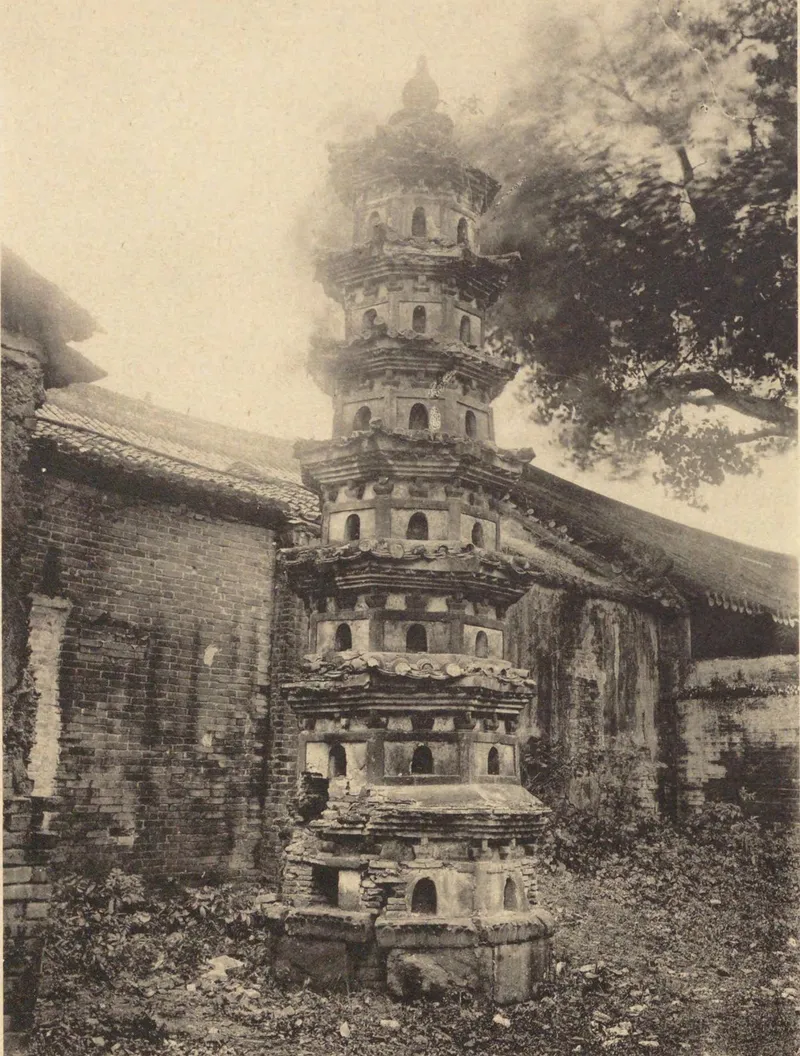
One of the old photographs of the Sixth Patriarch’s Hair-Burial Pagoda collected in Volume III of Shina Bunka Shiseki, its caption noting that it was photographed in the forty-third year of the Meiji era.
1928
Old photographs of Guangxiao Temple collected in Volume III of Shina Bunka Shiseki; among them, the old photograph of the central gate shows the plaque of the “Guangdong Judges’ School.”
Related Resources
- Luo Xianglin, Guangzhou Guangxiaosi Tangdai Beixin Tuoluoni Jingchuang Kao (A Study of the Tang-dynasty Compassionate-Mind Dharani Sutra Pillar of Guangxiao Temple, Guangzhou), Guangdong Wenwu Teji (Special Collection on Guangdong Cultural Relics), 1949, vol. 1. NTU Digital Library of Buddhist Studies
- Gu Zhengmei, Guangzhou Guangxiaosi Er Tieta de Jianzao Xingzhi (The Nature of the Construction of the Two Iron Pagodas of Guangxiao Temple, Guangzhou), Tianye yu Wenxian: Huanan Yanjiu Ziliao Zhongxin Tongxun (Fieldwork and Documents: Newsletter of the South China Research Center), 2009, no. 57. Entry, PDF
- Chen Hongjun, Guangzhou Guangxiaosi Nanhan Dongxi Er Tieta Ming Kaoshi (An Interpretive Study of the Inscriptions of the Southern Han Eastern and Western Iron Pagodas of Guangxiao Temple, Guangzhou), Lingnan Wenshi (Lingnan Literature and History), 2012, no. 2. PDF
- Cheng Jianjun, Guangzhou Guangxiaosi Daxiong Baodian Damu Jiegou Yanjiu (A Study of the Great-timber Structure of the Great Hero Hall of Guangxiao Temple, Guangzhou), Journal of South China University of Technology (Natural Science Edition), 1997. Architectura Sinica entry
- Gu Guangxiu and He Cong, comps., Guangxiaosi Zhi (Gazetteer of Guangxiao Temple), compiled during the Qianlong era, reprinted by the Guangdong Compilation and Printing Bureau in the twenty-fourth year of the Republic. DILA Buddhist Temple Gazetteers
- Related search of Wenwu Chunqiu: no dedicated article on Guangxiao Temple has been found for now; the NTU Digital Library of Buddhist Studies “dharani sutra pillar” search page can serve as an entry point for comparable entries. Search page