Introduction
The Weizang Tongzhi records: when the Tibetan king Songzan Gambu was establishing the Dazhao Temple, he went to Ya’erlong and saw a small lake in which dwelt a five-headed demon serpent. He “dispatched Juela to transform into a roc and slay it; the lake water turned entirely red, and the water then receded.” After the water retreated, “a temple was built upon that ground,” enshrining nineteen Sangdui Buddhas, one of which was “a self-formed image,” with “five pagodas built above to subdue it.” Ya’erlong refers to the Yarlung River valley area — the legend of Changzhu Temple is therefore not the story of a single isolated monastery, but part of the narrative of Tubo royal power spreading Buddhist temples into the heartland of Yarlung.
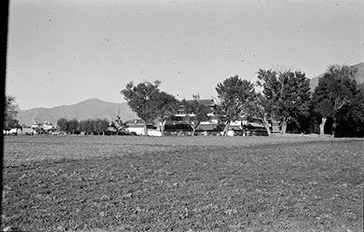
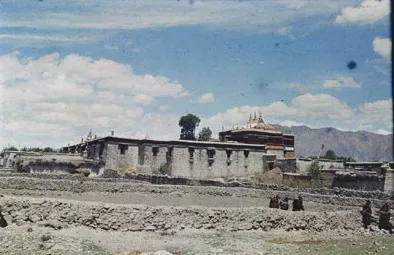
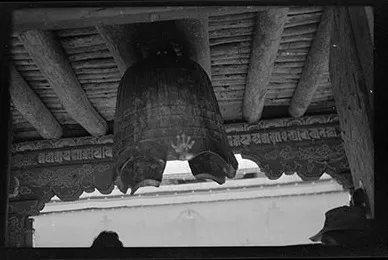
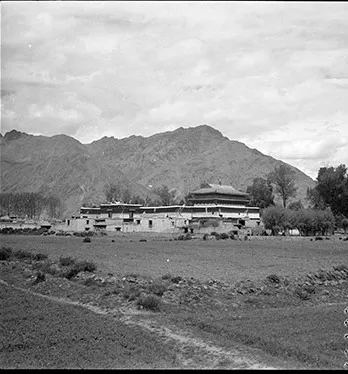
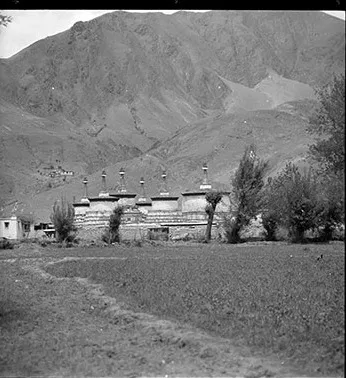
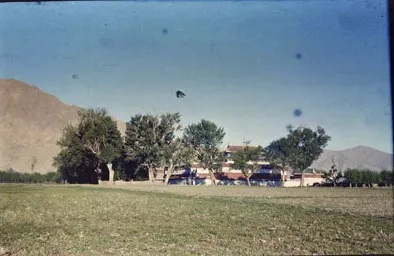
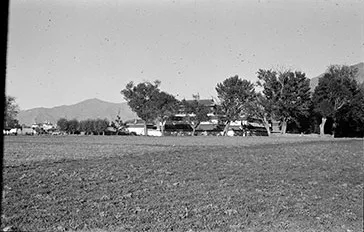
Thirteen hundred years later, in 1949, Hugh E. Richardson photographed this temple along his Yarlung and Chongje route. The Tibet Album labels these images as Tradrug / Khra ’brug: a distant view of the temple beyond fields, the courtyard walls and golden roofs, an ancient bell in the gate portico, and stone pagodas and sutra pillars before the courtyard — the very ground where legend says “the water receded and a temple was built” appears in the photographs still as a monastery surrounded by broad farmland.
Historical Documents
Weizang Tongzhi
藏王曲结、松赞噶木布修立大昭之时,赴雅尔咙等处,见一小海子,内有妖蛇五首,欲将海水犀乾上建庙宇,遣觉拉化为鹏斩之,海水尽赤,水遂消。乃于其地修建庙宇,供奉桑堆佛十九尊,其一尊乃不上自成之像,上建五塔以镇之。又塑佛母伊兴科尔洛像、罗金褚旺像、苍巴洞托尔足像。又修极乐寺弥勒寺,相传至今一百四十余年。
When the Tibetan king Qujie Songzan Gampo was establishing Dazhao, he went to Yarlung and other places. He saw a small lake in which there was a monstrous serpent with five heads, and wished to dry up the lake and build a temple on it. He sent Juela to transform into a roc and cut it down; the waters all turned red, and the water then disappeared. A temple was therefore built on that place, enshrining nineteen Sangdui Buddhas; one of them was an image formed of itself, and five stupas were built above it to hold it down. Images were also made of the Buddhist mother Yixing Ke’erluo, Luojin Chuwang, and Cangba Dongtuorzu. The Jile Temple and Maitreya Temple were also built; it is said that more than one hundred and forty years have passed since then.
Historical Photographs
1949
Hugh E. Richardson photographed Tradruk Temple during his 1949 journey through Yarlung and Chongye. The Tibet Album catalogues the images as Tradrug / Khra ’brug and includes a distant temple view, walls and gilded roofs, a bronze bell in the porch, a black-and-white distant view, stupas and prayer pillars before the temple, and a color distant view. The images below are cropped to the photographic frame, removing scan edges and slide borders from the web previews.